Credit Coach
Ux Case Study
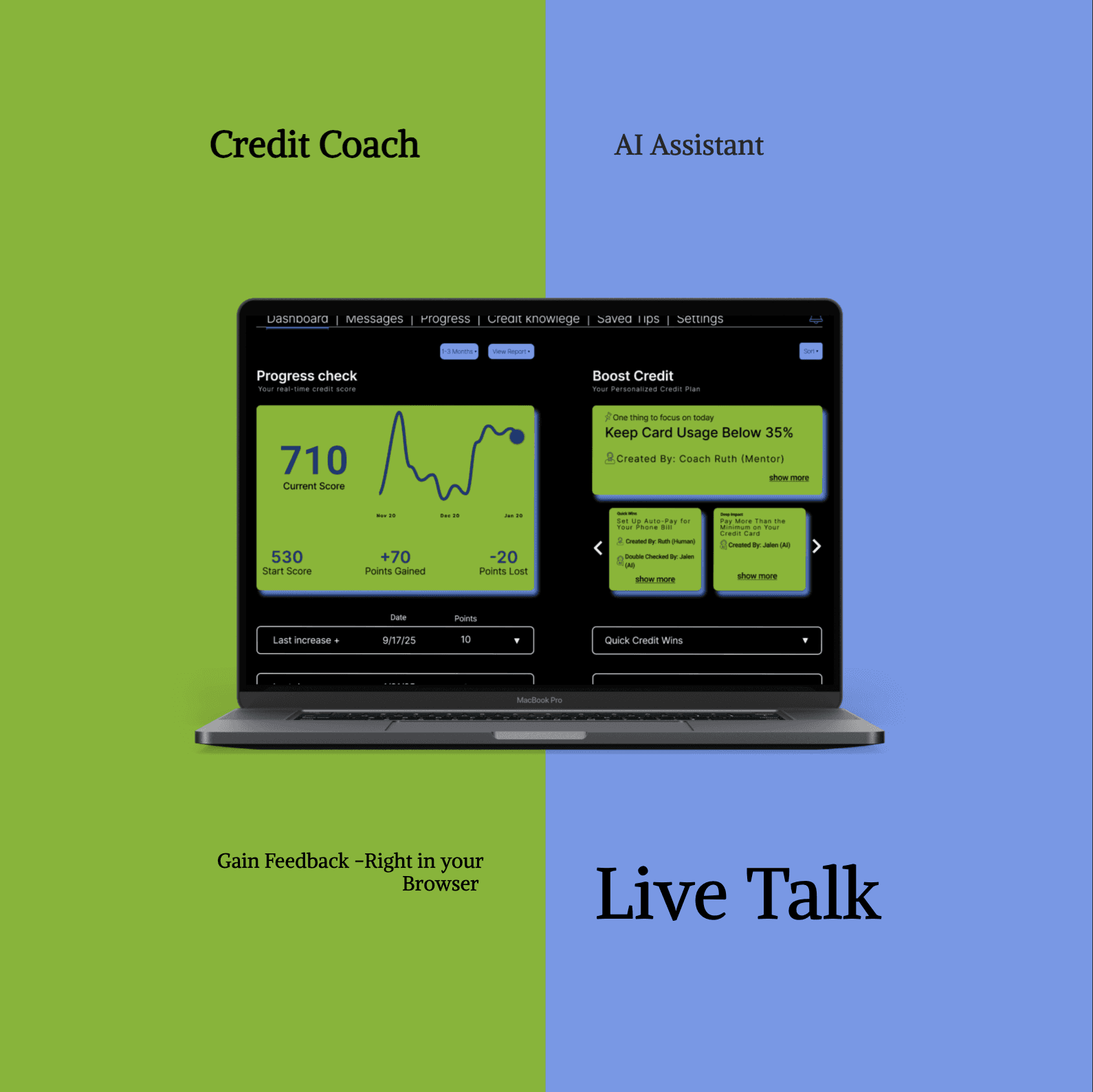
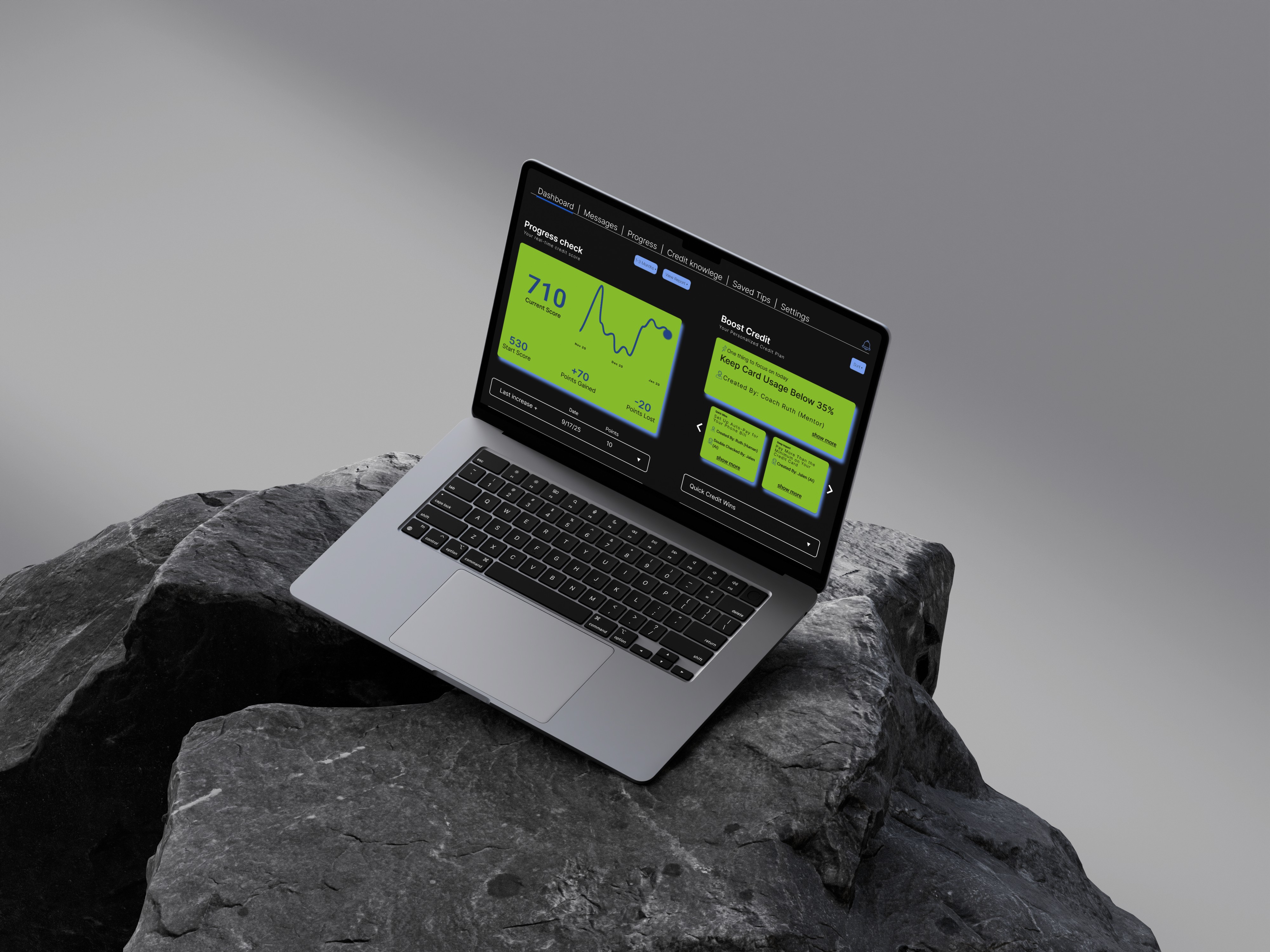
Credit Coach combines AI-powered insights with human coaching to provide personalized, proactive credit guidance. From your dashboard to your browser, it delivers timely support that helps you make smarter financial decisions.
Role:
Lead Product Designer
Industry:
Fintech
Timeline:
4 Months
Platform:

Overview
Many individuals navigating credit struggle with impersonal apps that offer surface-level tips, lacking the real-time support and context they need to improve confidently. The financial space needed a more intuitive, empowering platform that speaks directly to everyday users and meets them where they already are—online.
Problem Area
Traditional credit tools often overwhelm users with jargon, scattered features, and limited feedback. Without timely guidance or human empathy, users miss opportunities to improve their credit or avoid harmful financial decisions in the moment they matter most.
Solution
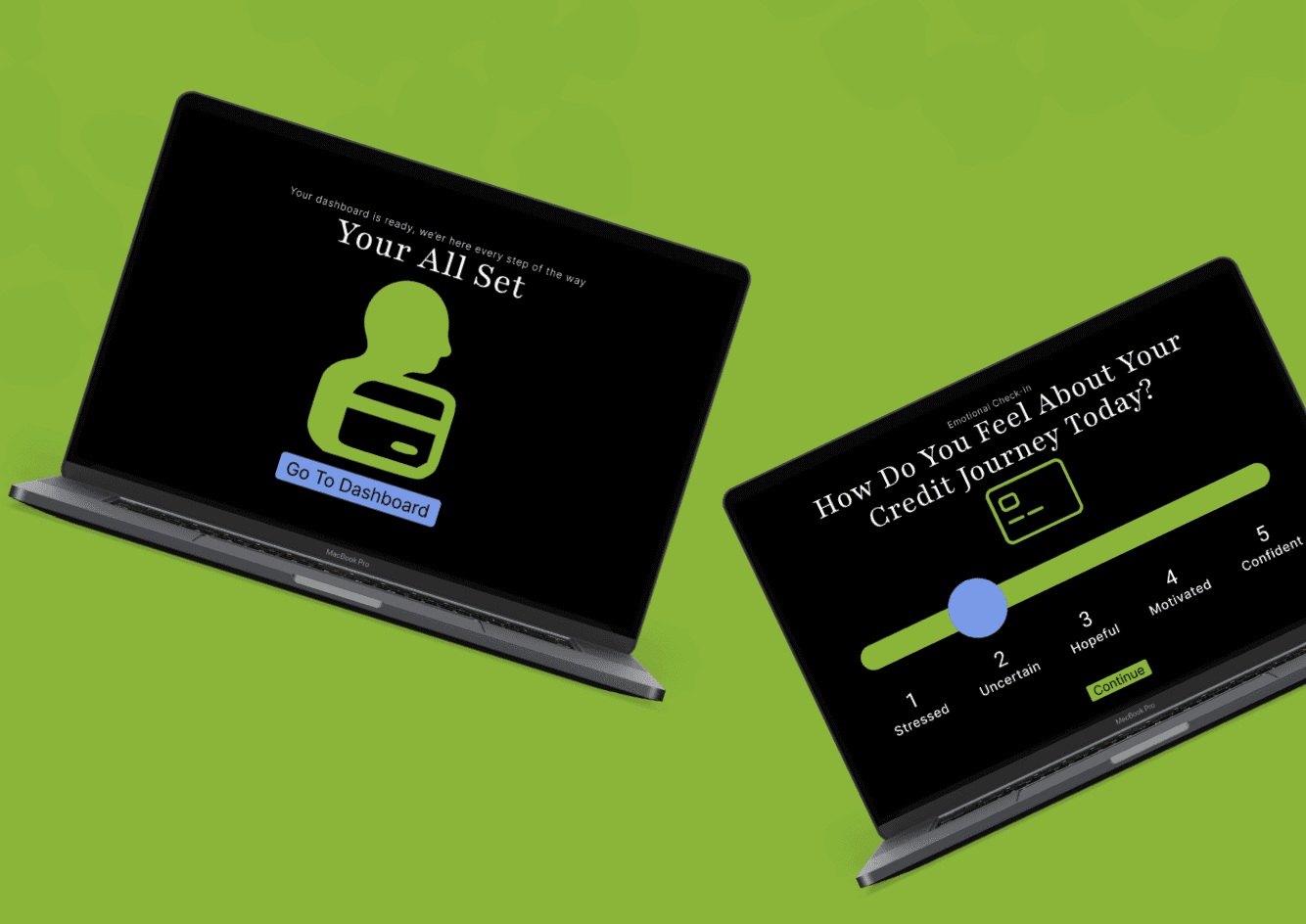
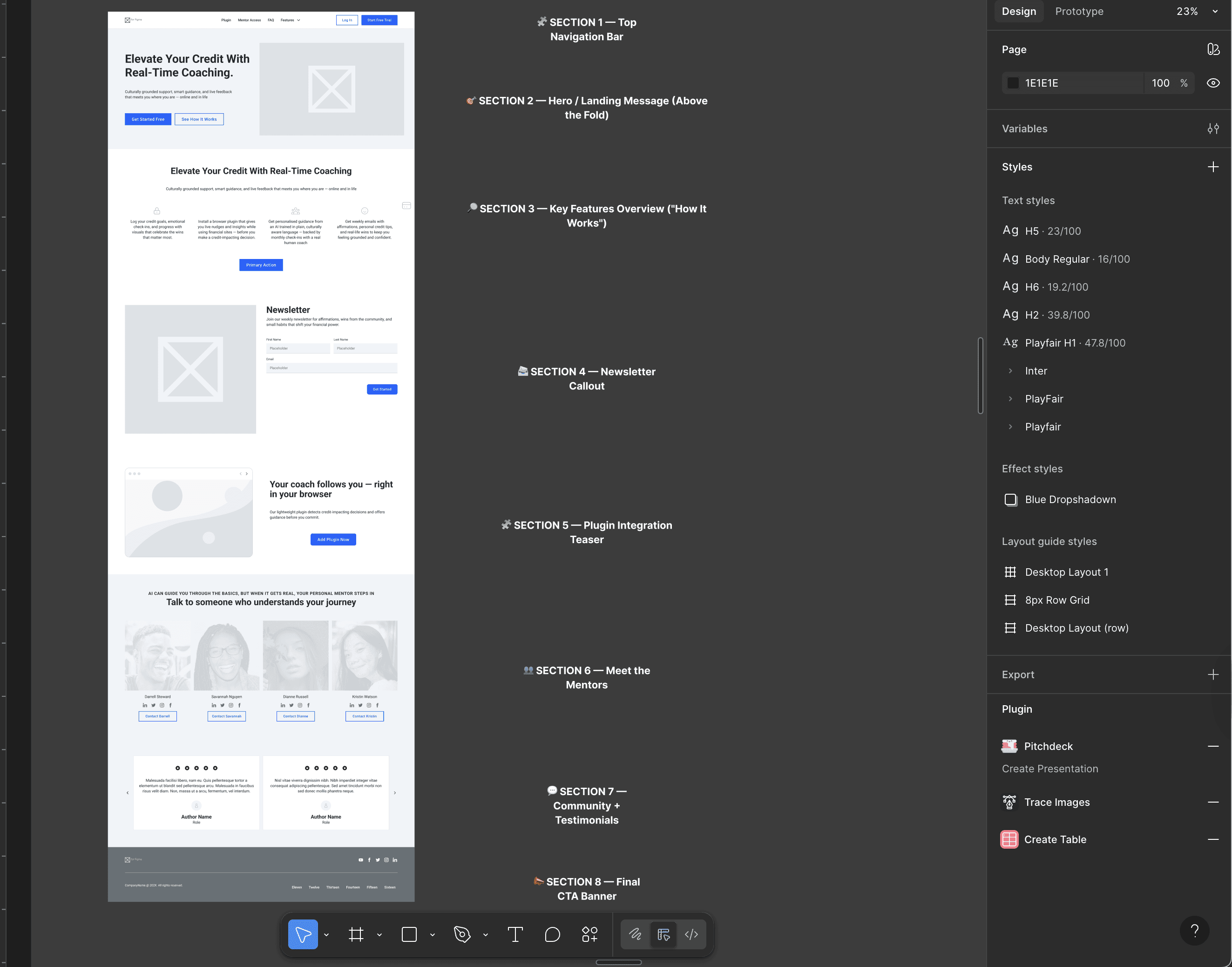
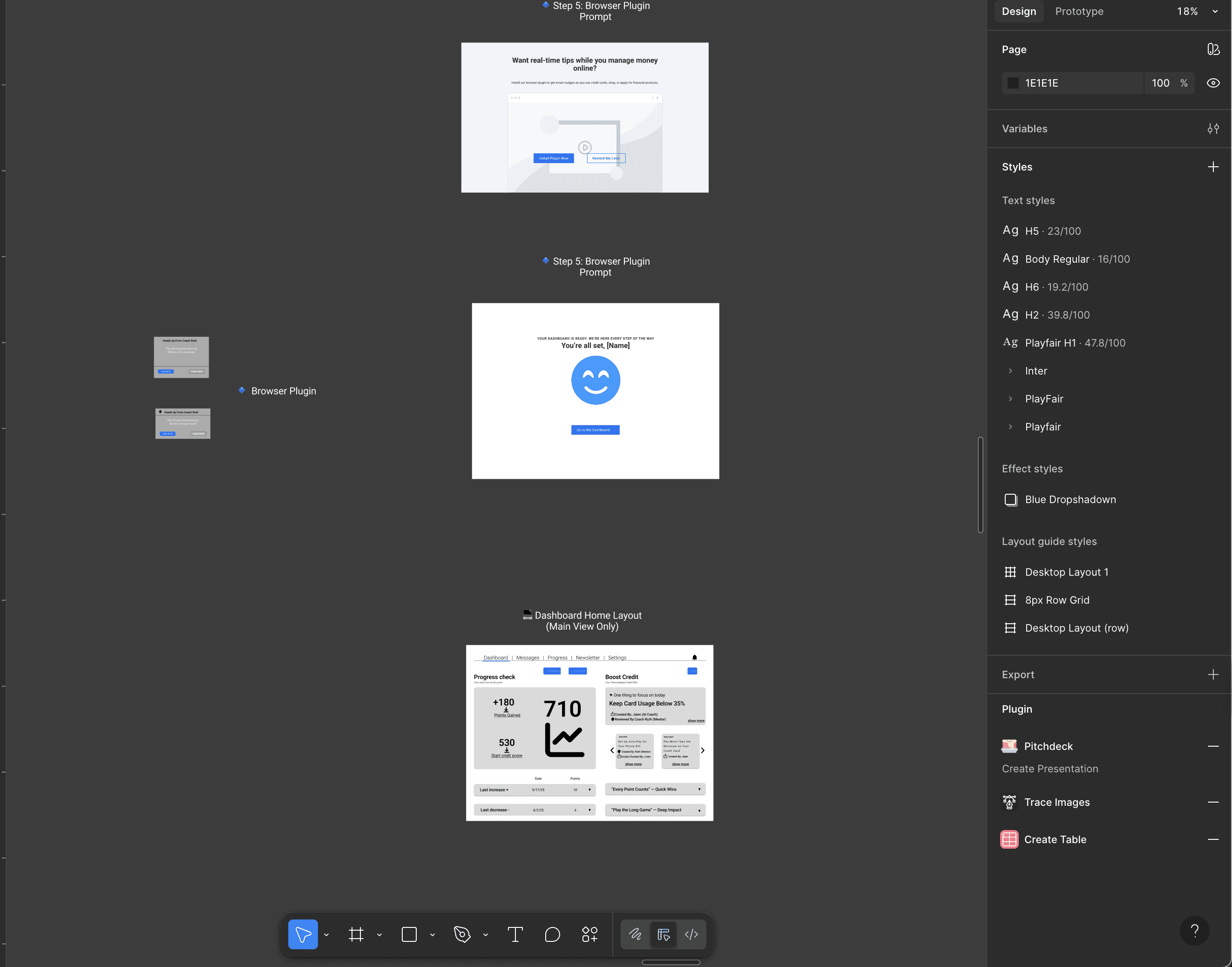
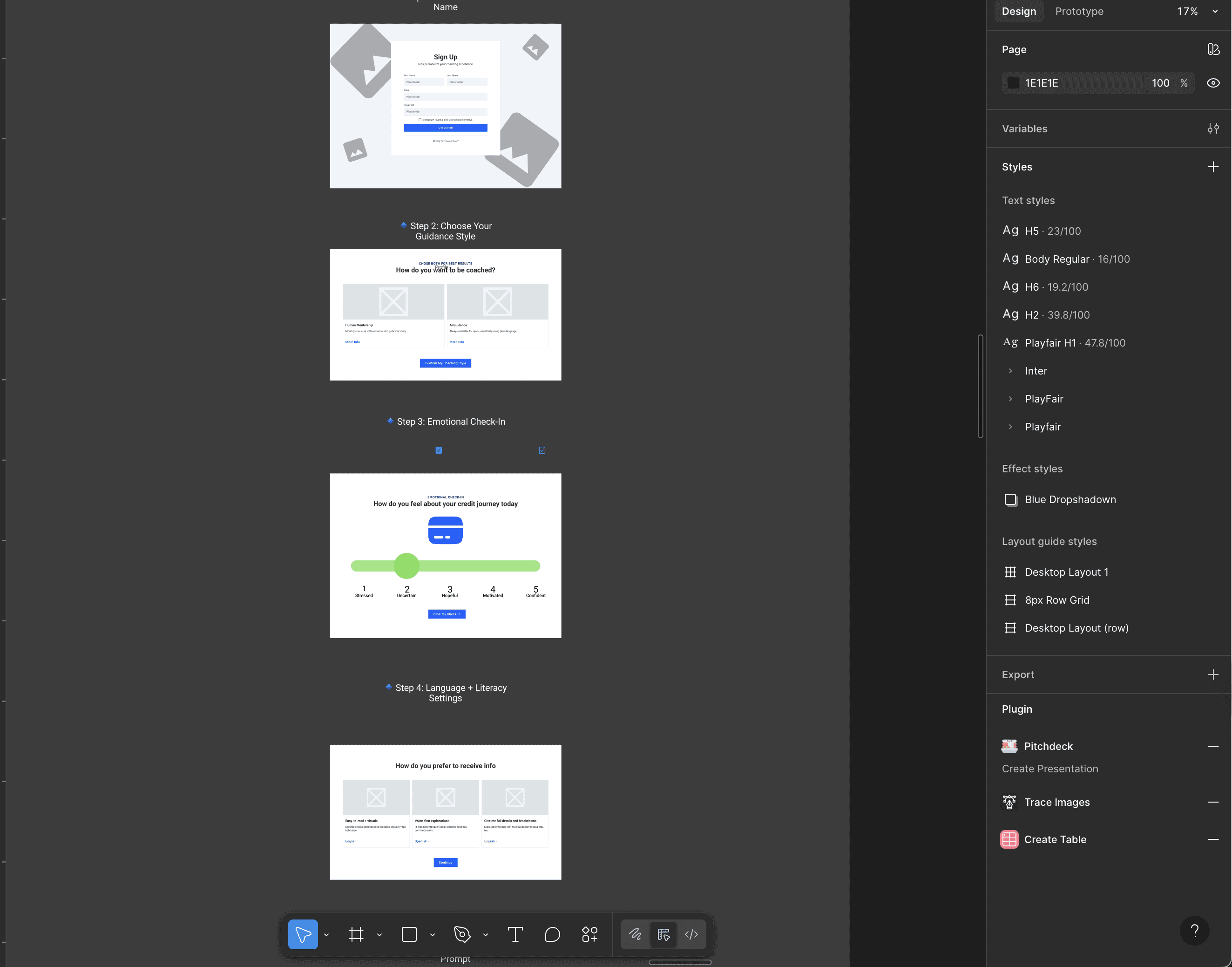
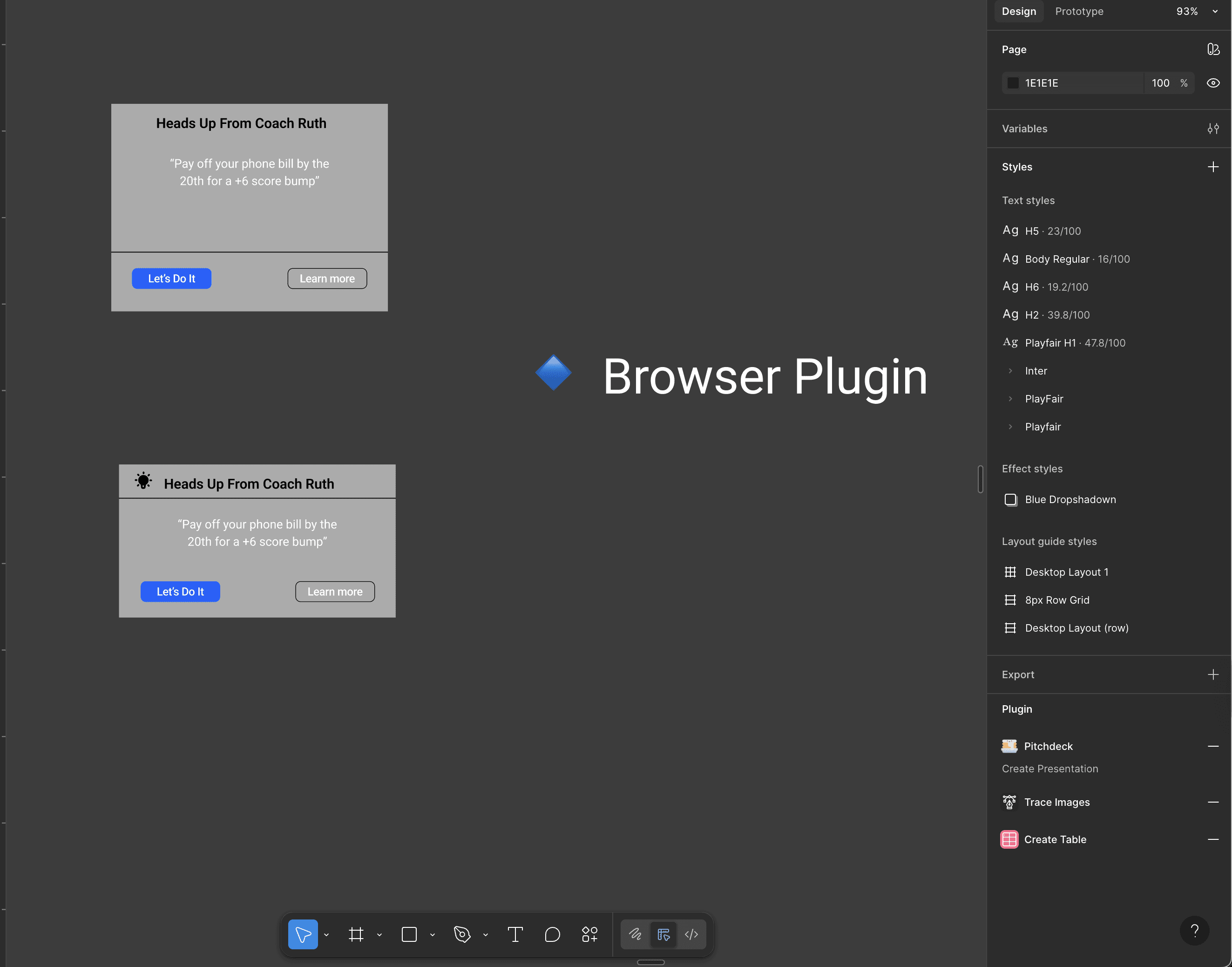
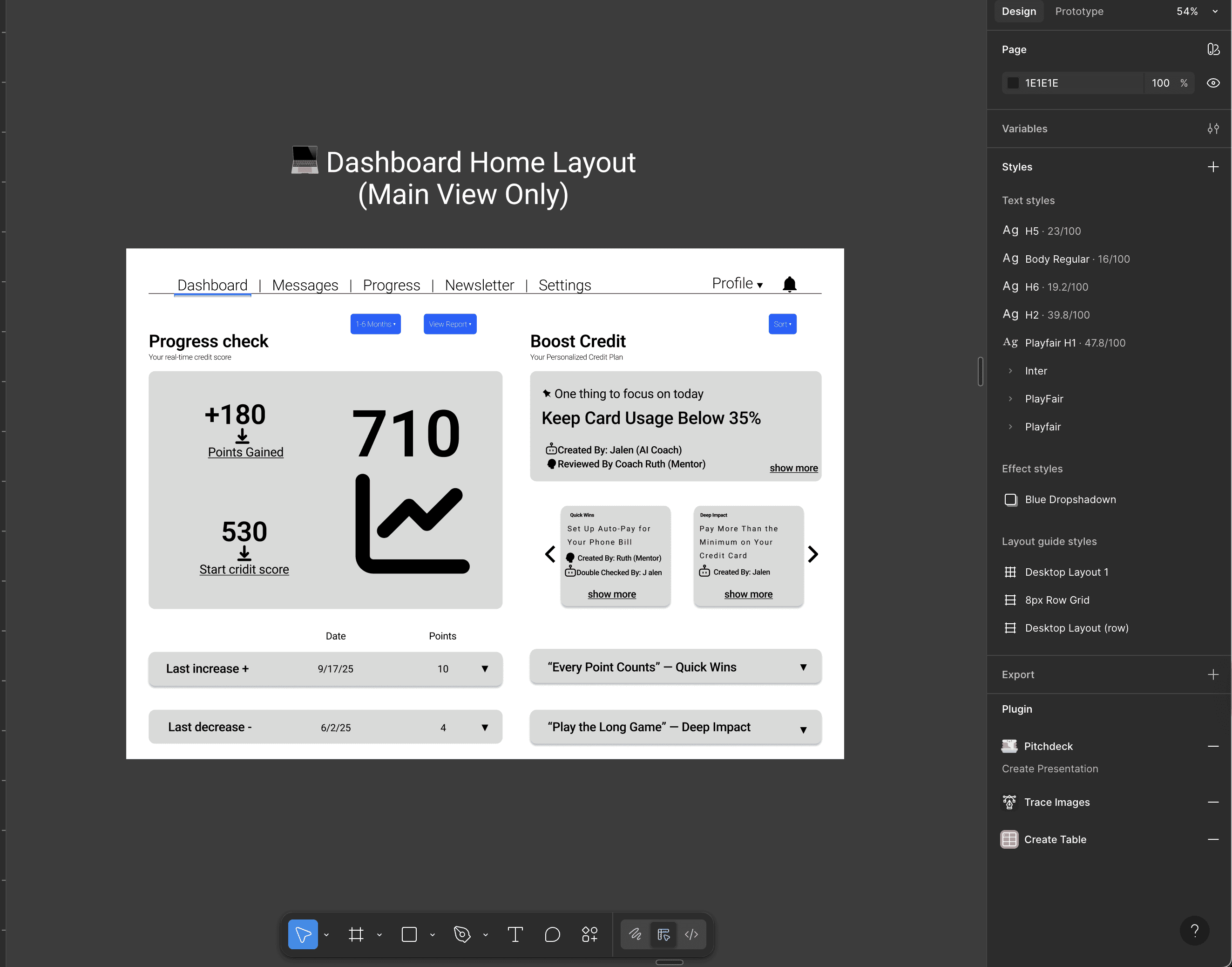
I designed a hybrid platform combining an AI-powered browser plugin with personalized human coaching, offering real-time suggestions, clear education, and emotional support. The experience blends proactive alerts, relatable insights, and actionable steps to make credit health approachable and interactive.

Project images
hey


Conducting User Interviews, Market Research, and Competitive Analysis Revealed the Systemic Barriers Preventing Families from Building Credit
Ux Resarch section
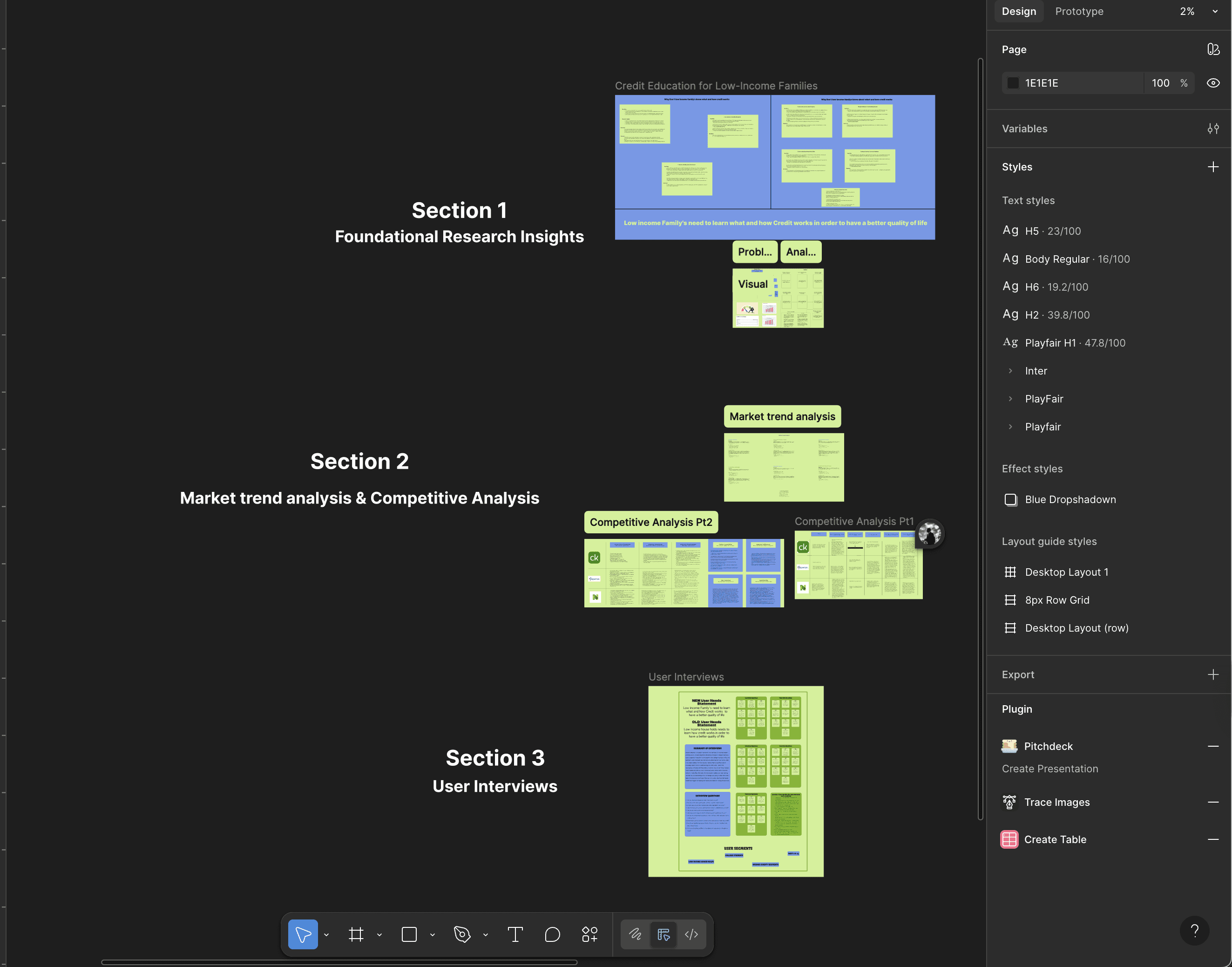
The goal of my market trend and competitive analysis was to understand how financial wellness platforms are addressing consumer needs and where gaps still exist for low-income families. I found that while companies like Credit Karma, Experian, and NerdWallet offer strong tools for credit monitoring, education, and financial management, they often target broad audiences and overlook systemic barriers faced by vulnerable groups. This revealed an opportunity to design solutions that are more inclusive, community-centered, and supportive of long-term stability. I completed this analysis by reviewing industry reports, consumer trend studies, and competitive landscapes from sources such as PwC, Deloitte, and industry outlook publications.
The goal of my user interviews was to better understand how low-income families, especially students and young adults, currently view and manage credit. Through conversations with Umoja program members and community participants, I learned that while many understood the basic concept of credit, there was still significant confusion about how to build it, avoid mistakes, and use it for long-term financial goals. A common theme was the struggle to stay consistent with payments and the lack of accessible guidance. These insights confirmed that low-income households need more tailored, practical education around credit use. I gathered this research directly from interviews with target users in my community.
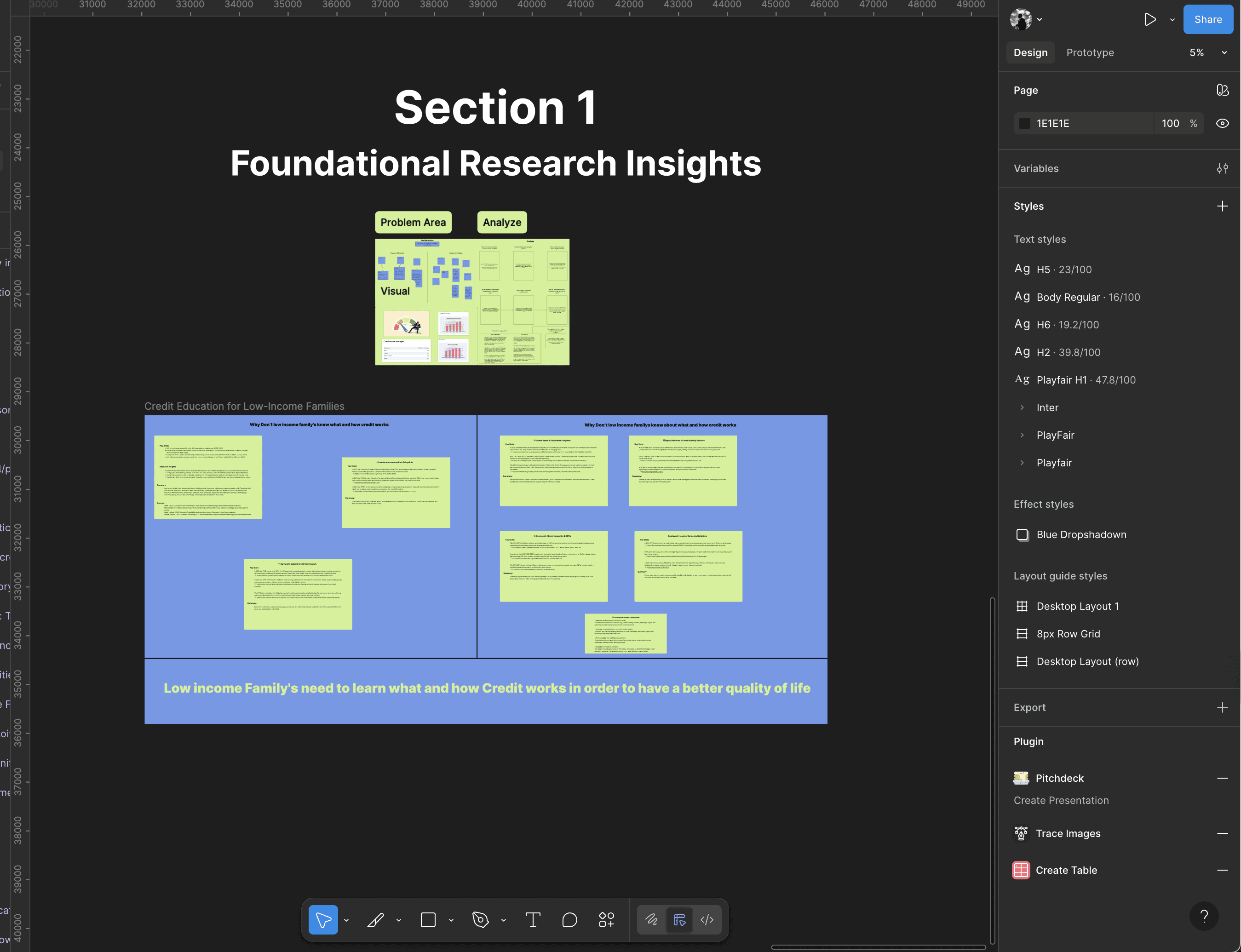
Foundational Research Insights
Summary (Goal → Outcome):
My research began with two core questions: Why don’t low-income families know what credit is/how it works? and Why is credit education often inaccessible? To answer these, I turned to trusted sources like the CFPB, FDIC, Federal Reserve, and Urban Institute, because they provide reliable, nationally recognized data on consumer credit behavior, systemic barriers, and financial well-being. I chose these sources specifically for their credibility, depth, and direct connection to underserved communities, which allowed me to uncover the structural and behavioral gaps behind credit literacy.
Outcome: I found that the challenge is not a lack of resources—but rather a lack of consistent, accessible, and trusted delivery of those resources. This insight shaped my problem statement: Low-income families need clear, timely, and culturally relevant pathways to understand and build credit in order to improve their quality of life.
Core Pain Points
Low-Income Communities: Systemic Barriers
Families face economic trade-offs that push credit learning to the background.
Limited access to financial institutions, safe credit products, and trustworthy information.
Generational gaps mean knowledge transfer is inconsistent.
Barriers to Building Credit from Scratch
Rent and utility payments rarely counted toward scores despite being major expenses.
Families often lack co-signers or starter credit lines, creating a “cold start” problem.
Many first-time users make small mistakes (missed payments, high utilization) that have outsized negative impacts.
Credit Education Is Rare and Inaccessible
Only a handful of states require financial literacy courses in schools.
Adult and continuing-ed programs are inconsistent, often underfunded, and not tailored to cultural/linguistic needs.
When available, education is usually static (workshops, pamphlets) and disconnected from real-time financial decision-making.
Solution Channels Reviewed
School-Based & Educational Programs
Structured curricula can improve baseline literacy, but adoption varies and rarely reaches adults.
Digital Platforms & Credit-Building Services
Apps and credit-monitoring tools provide access, but they are impersonal, paywalled, and context-blind without human coaching.
Employer & Housing-Connected Initiatives
Rent reporting and employer-linked programs show measurable gains, but participation depends on landlords/HR adoption.
Community-Based Nonprofits & CDFIs
Trusted and culturally resonant, but limited by resources and scale. Strong when paired with coaching and accountability.
Key Insights (Cross-Cutting)
Consistency over intensity: Families need small, repeated actions (pay on time, report rent) guided in real time.
Trust matters: Community-based organizations build credibility, but digital platforms scale reach.
Signals gap: Rent, utilities, and everyday bills are not fully recognized by traditional credit scoring.
Context wins: Support must happen in the flow of decision-making, not in disconnected lessons.
UX Insights & Strategic Opportunities
In-flow coaching: Real-time AI nudges during bill pay, checkout, or financial forms.
Signal pipeline: Build credit by reporting non-traditional payments like rent, phone, or utilities.
AI + Human loop: Pair automated guidance with coach verification for trust and accountability.
Partner mode: Equip schools, landlords, employers, and nonprofits with plug-in dashboards to extend reach.
Cultural & language fit: Ensure material is plain-language, multilingual, and tied to local community values.
Sources (Why These Were Chosen)
CFPB (Consumer Financial Protection Bureau): Federal authority on consumer credit data, ensuring accuracy and regulatory perspective.
FDIC (Federal Deposit Insurance Corporation): Tracks unbanked and underbanked households, directly relevant to low-income family challenges.
Federal Reserve: Provides national insights into household economic well-being, lending patterns, and financial inclusion.
Urban Institute: Known for detailed community-level studies, especially rent reporting and nonprofit-based financial programs.
Council for Economic Education & FINRA Foundation: Offer educational benchmarks and financial literacy gaps across states and demographics.
Market trend analysis & Competitive Analysis
Summary (Goal → Outcome):
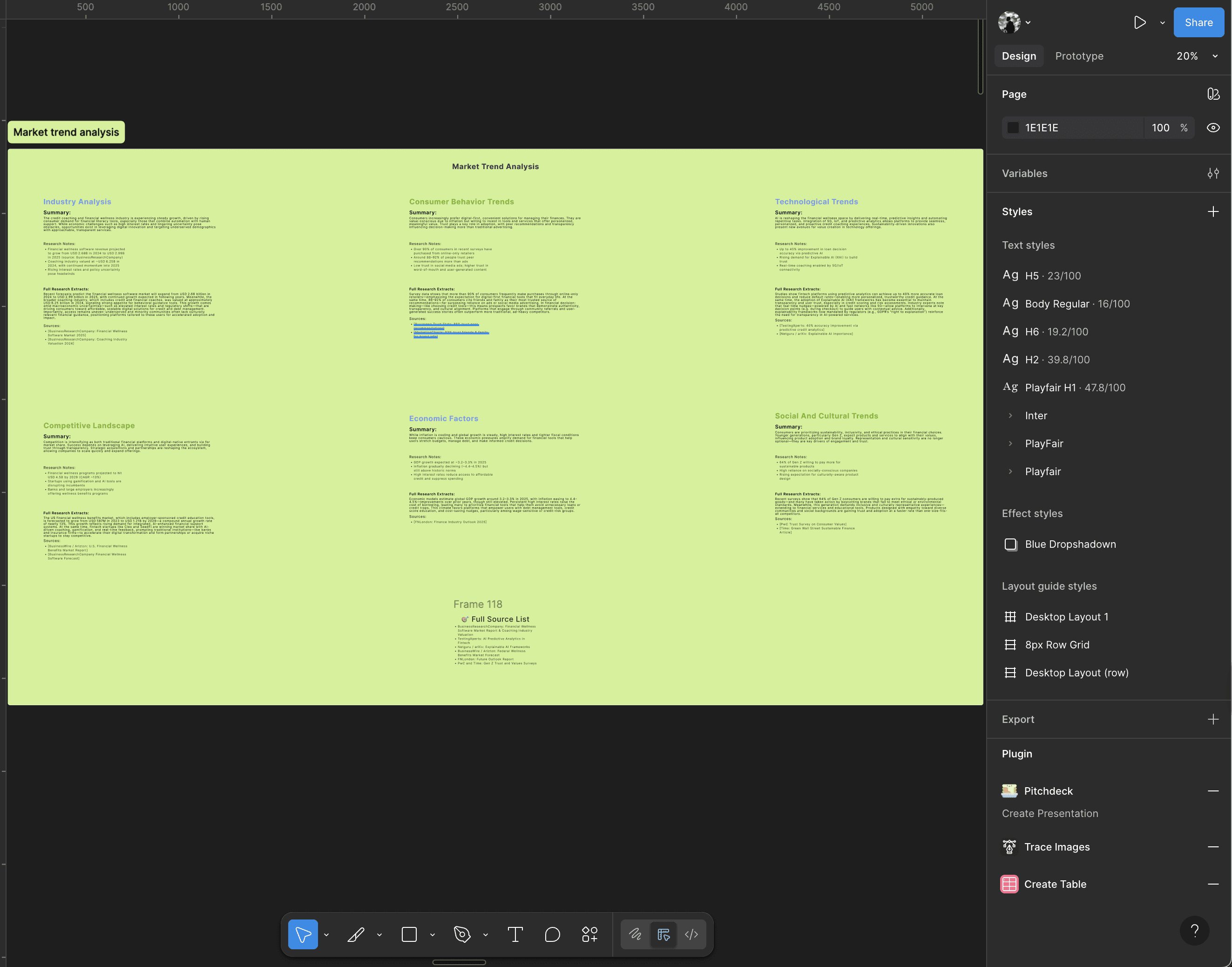
The goal of my research was to understand both the broader shifts in the financial wellness industry and the strategies of leading competitors in credit education. To do this, I conducted a market trend analysis using industry reports and consumer studies, and a competitive analysis where I reviewed the websites and product offerings of Credit Karma, Experian, and NerdWallet. By engaging directly with their platforms, I was able to evaluate what they offer users, where they succeed, and where they fall short.
The outcome revealed that while competitors provide strong credit monitoring and education services, they lack inclusivity, cultural relevance, and real-time personalized guidance for low-income families. Market insights confirmed that users increasingly want mobile-first, AI-powered, and emotionally supportive financial tools. This validated the direction of my final product: an AI + human hybrid coaching platform designed to meet underserved users where they already are—online.
Market Trend Analysis
Industry Analysis
What I Learned
Financial wellness is steadily growing, led by fintech innovation.
Most providers prioritize scale and profit over inclusion.
Education exists but is too generic or technical for underserved users.
Why I Did It & Contribution
I studied industry growth to confirm whether there was room for an inclusive product. This revealed that the market is expanding but overlooking equity-centered solutions—a gap my project directly addresses.
Consumer Behavior Trends
What I Learned
Over half of consumers want tools that explain the “why” behind changes.
Younger audiences demand mobile-first, simplified experiences.
Trust comes from clear explanations and emotional reassurance rather than generic alerts.
Why I Did It & Contribution
I analyzed consumer behavior to align with user expectations. This confirmed the need for a platform that feels human, intuitive, and culturally relevant, beyond just numbers.
Technological Trends
What I Learned
AI increases prediction accuracy and automates credit recommendations.
Predictive analytics can guide risk reduction for everyday users.
Current solutions lack explainability and human support.
Why I Did It & Contribution
I examined technology to learn how AI could strengthen credit education. This confirmed the opportunity to merge AI-powered insights with human coaching, balancing scale with empathy.
Economic Factors
What I Learned
Inflation and cost-of-living pressures worsen credit instability.
Low-income families are disproportionately excluded from credit systems.
Financial instability increases the demand for practical, accessible tools.
Why I Did It & Contribution
I reviewed economic conditions to ensure the product was grounded in reality. This showed my solution needed to be accessible and affordable, even during hardship.
Social & Cultural Trends
What I Learned
Users demand culturally relevant, trustworthy platforms.
Gen Z and Millennials expect products to reflect their lived experiences.
Representation and empowerment are now key adoption drivers.
Why I Did It & Contribution
I studied cultural trends to make sure the product would resonate emotionally. This reinforced the importance of designing for representation, empowerment, and trust.
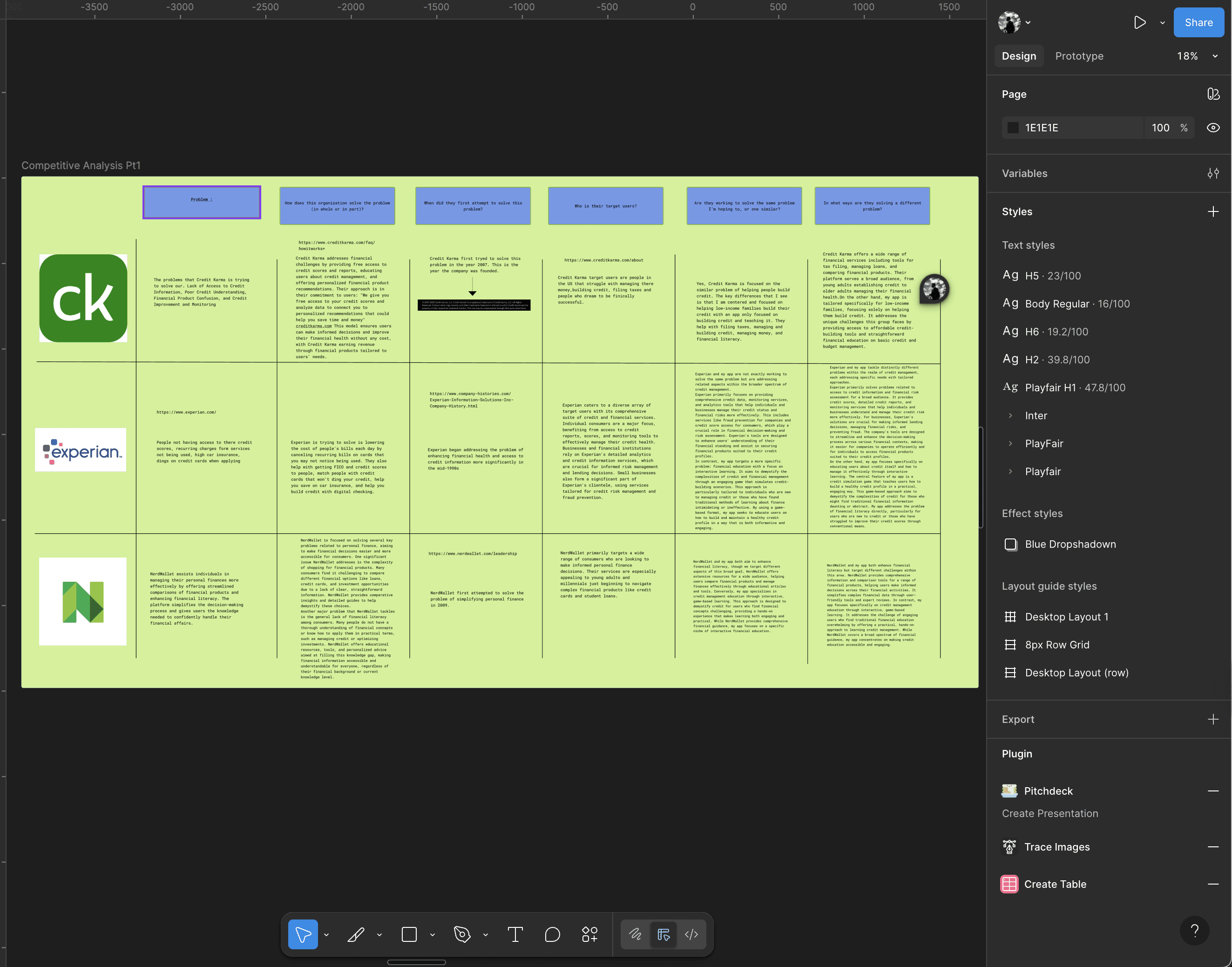
Competitive Analysis
Credit Karma
What I Learned from Reviewing the Site
Strengths: Free tools, credit monitoring, broad reach, simple UX.
Weaknesses: Relies on affiliate marketing, advice is generic not contextual, little human support.
Why I Did It & Contribution
I analyzed Credit Karma because it’s the most well-known consumer tool. Its gaps highlighted the opportunity to deliver contextual, real-time coaching that feels tailored to each user.
Experian
What I Learned from Reviewing the Site
Strengths: Authoritative data, Experian Boost feature, global trust.
Weaknesses: Heavy on reporting, light on behavior-level coaching, enterprise-oriented tone.
Why I Did It & Contribution
I studied Experian as a market incumbent to see how established players shape trust. Its limits showed the need for a friendlier, more action-oriented product.
NerdWallet
What I Learned from Reviewing the Site
Strengths: Accessible content, side-by-side comparisons, user-friendly tone.
Weaknesses: Content-led vs. action-led, not real-time, lacks ongoing engagement.
Why I Did It & Contribution
I reviewed NerdWallet for its approachable style. Its gaps reinforced the opportunity to blend clear education with in-flow actions and sustained coaching support.
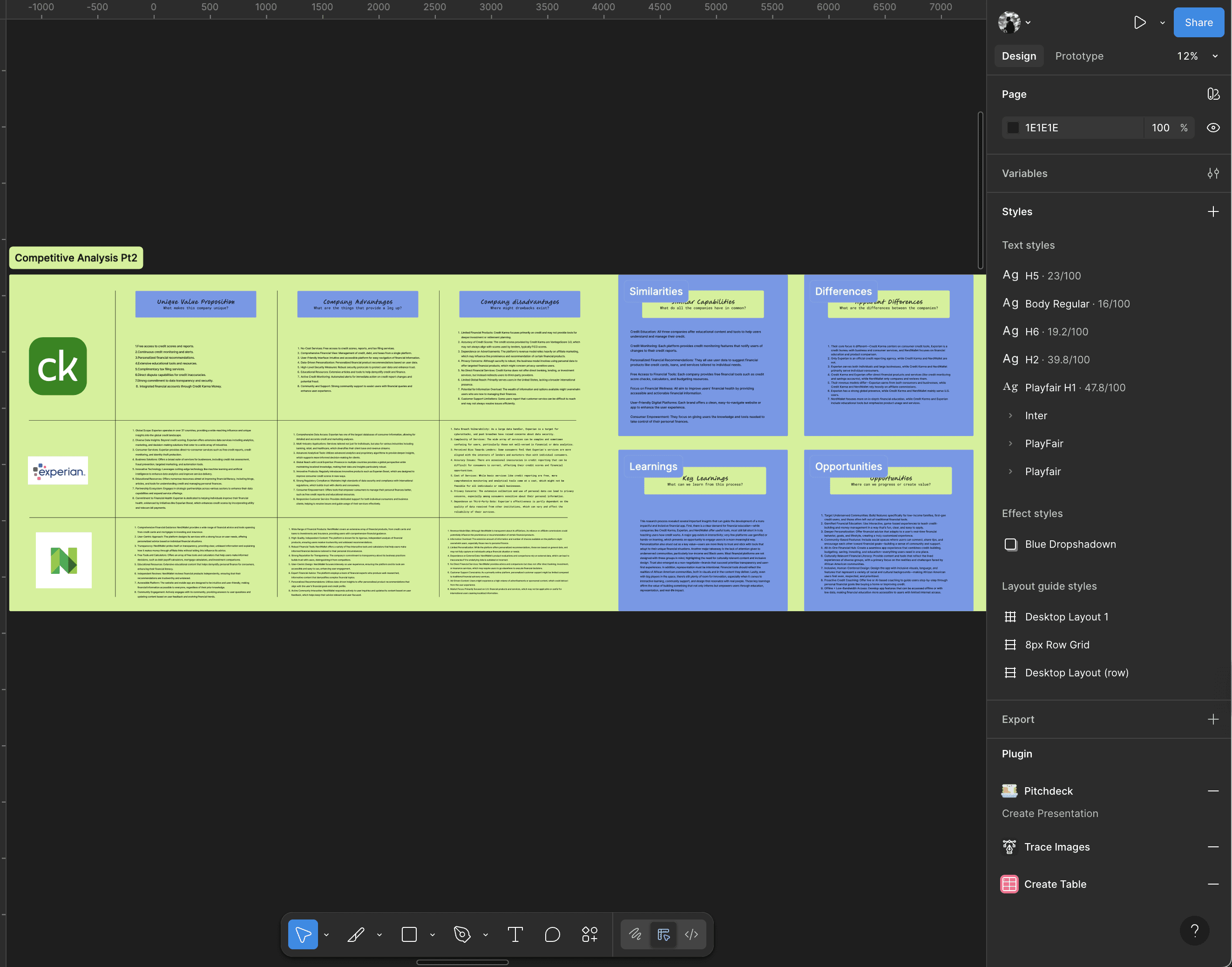
Cross-Competitor Learnings
Similar Capabilities: All provide credit monitoring + education.
Apparent Differences: Audience focus (consumer vs. institutional vs. content-led).
Key Learnings: None center their product on underserved communities.
Opportunities: Differentiate with AI + human coaching, cultural relevance, and empowerment-driven design.
Sources
Market Trend Analysis boards (Industry, Consumer, Tech, Economic, Social & Cultural)
Competitive Analysis boards (Credit Karma, Experian, NerdWallet)
Credit Karma official site – https://www.creditkarma.com
Experian official site – https://www.experian.com
NerdWallet official site – https://www.nerdwallet.com
CFPB – Consumer Credit Trends
Deloitte – Financial Wellness Industry Outlook
McKinsey – Fintech & AI Adoption Reports
Federal Reserve – Household Economic Well-Being Reports
User Interviews
Summary (Goal → Outcome):
The goal of my user interviews was to uncover how low-income students and families think about, understand, and experience credit in their everyday lives. To do this, I conducted in-person interviews by approaching students who met my criteria, explaining the case study, and asking if they had 10 minutes to participate. I collected emails and scheduled sessions when needed, while also conducting some interviews on the spot. Each conversation was held in a quiet area with minimal distractions, and I used open-ended questions to dig deeper into participants’ experiences. Notes were captured on both a notepad and iPad for accuracy.
Outcome
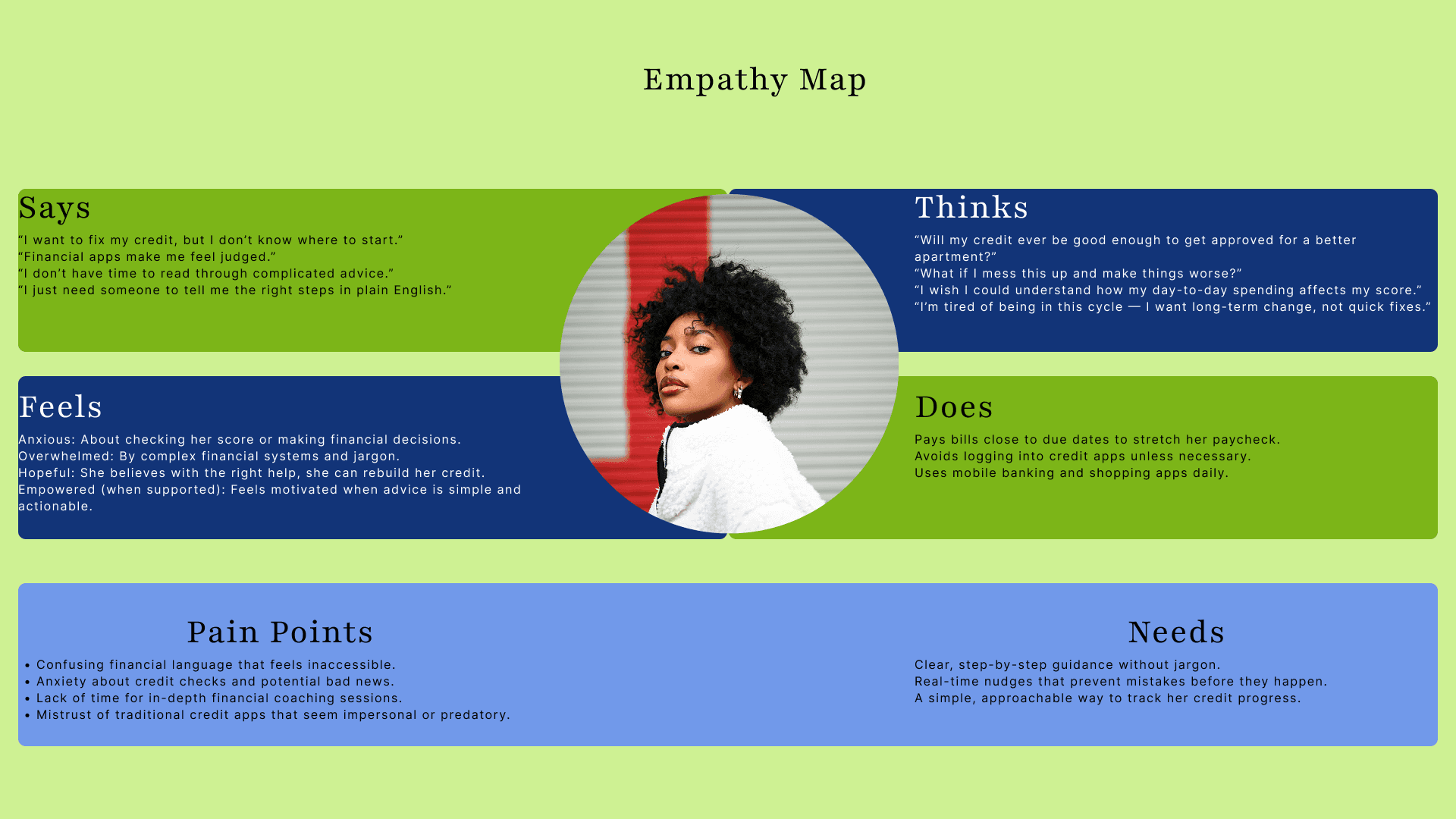
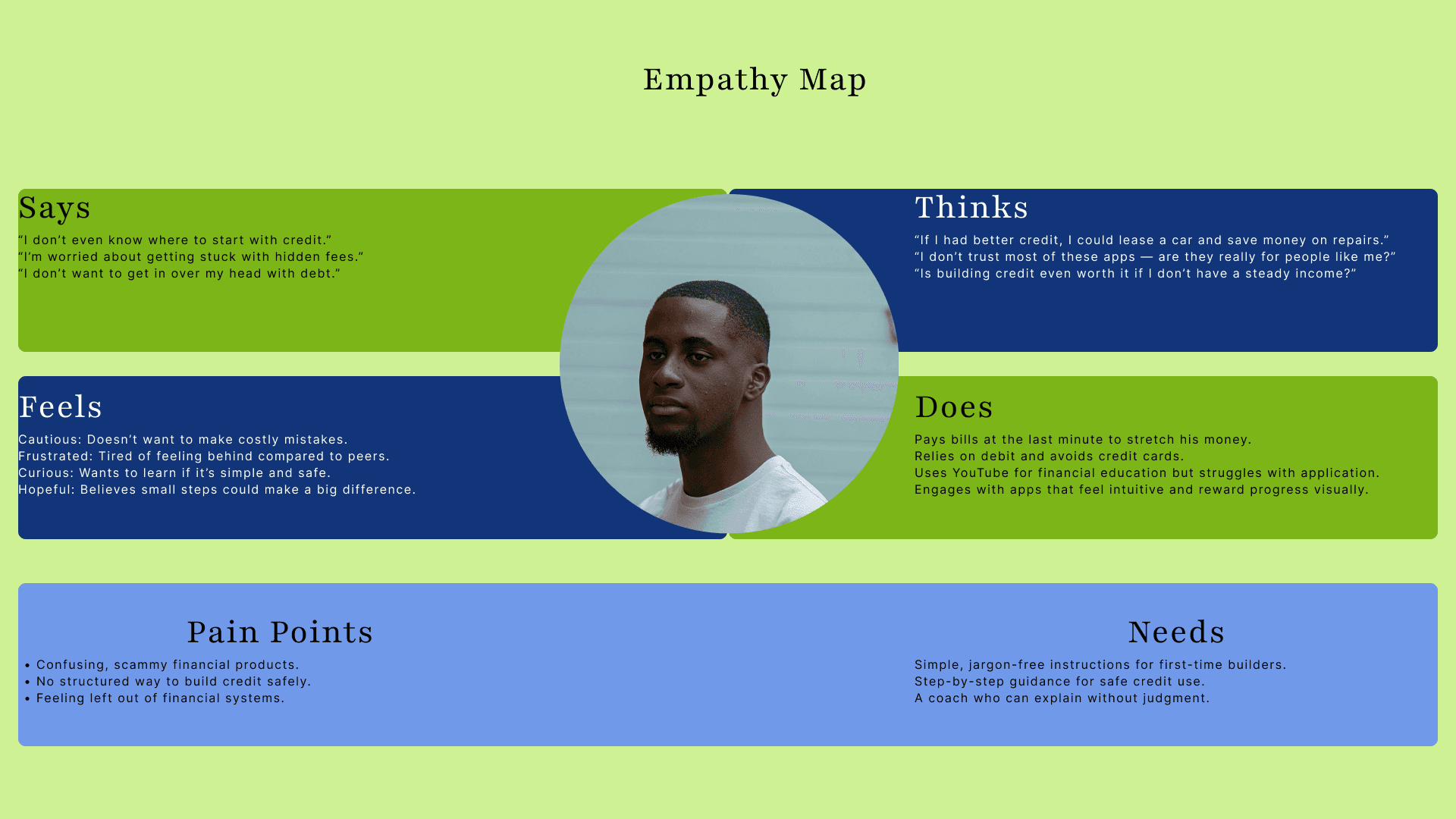
The interviews revealed that while participants were familiar with the word “credit,” most only had a surface-level understanding of how it truly works. Many had misconceptions, made costly mistakes, or felt excluded from systems that weren’t built with them in mind. A key finding was that most participants learned about credit primarily through their families—sometimes gaining helpful insights, but often inheriting confusion or misinformation. Participants also revealed struggles with accountability, managing payments, and lacking reliable guidance.
This process gave me a human-centered foundation that shaped my problem statement and ensured my solution was rooted in lived experience. Most importantly, it showed me that to build an effective solution, I needed to design experiences that don’t just target individuals but also resonate at the family and cultural level. This insight led me to believe the best way to create lasting impact was to “meet people where they are”—in the home, with culturally relevant tools, stories, and approaches that reflect the realities of their lives.
Key Insights
Surface-Level Understanding: Most participants knew what credit was but not how to build or repair it.
Family Influence: Credit knowledge was often passed down at home, sometimes inaccurately.
Missteps & Mistakes: Many had made errors due to limited knowledge, like missing payments or applying for credit at the wrong time.
Lack of Accessible Guidance: Few had trusted resources to turn to for credit questions or planning.
Accountability Struggles: Some admitted difficulty staying on top of bills or keeping themselves accountable.
Emotional Impact: Participants expressed feelings of stress and confusion when navigating credit.
Systemic Exclusion: Many felt existing tools and services weren’t built for their circumstances.
Sources
First-hand interviews conducted with students (ages 18–23) at Orange Coast College
Field notes captured via notepad and iPad
Participant follow-ups via email scheduling
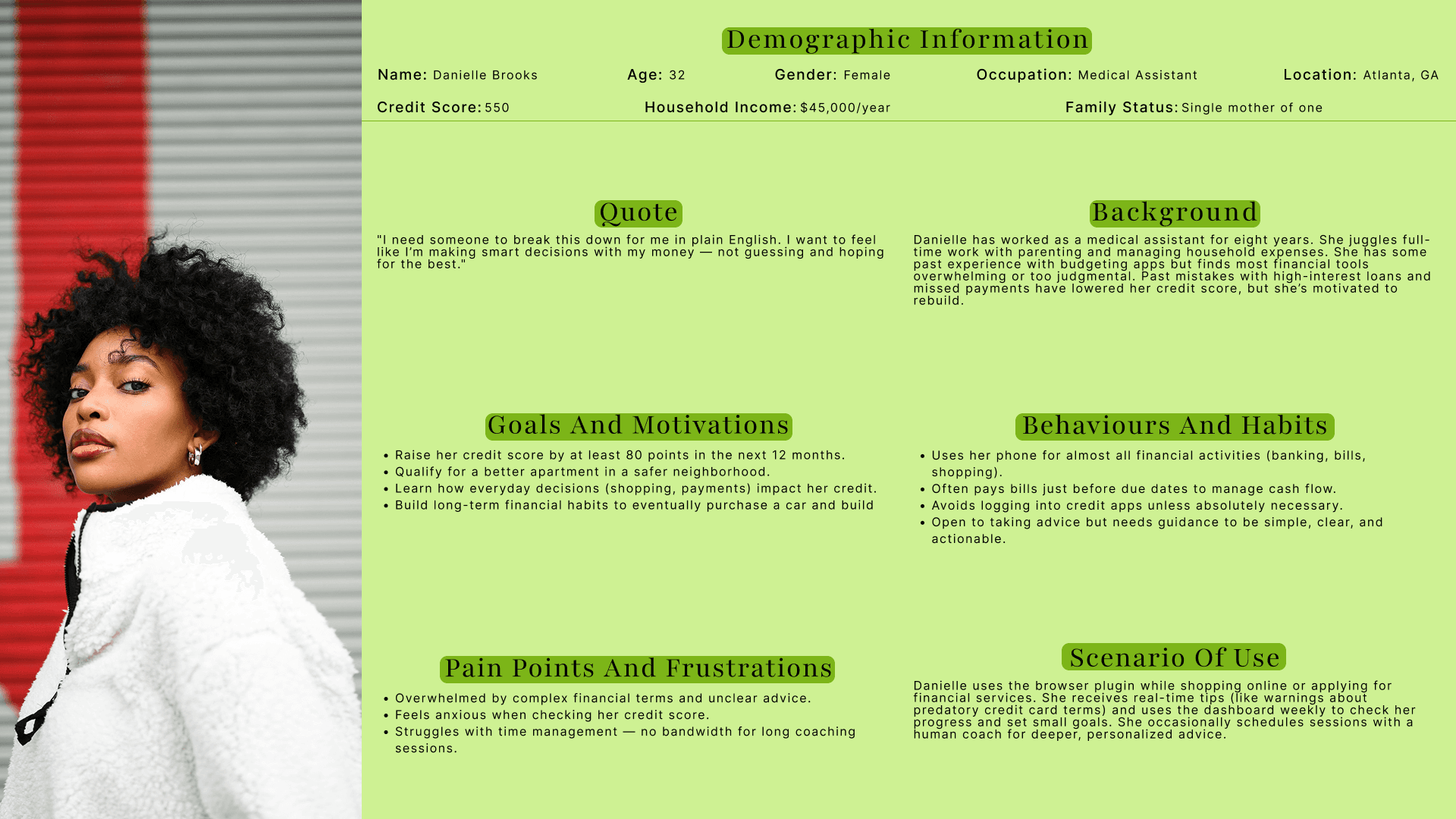
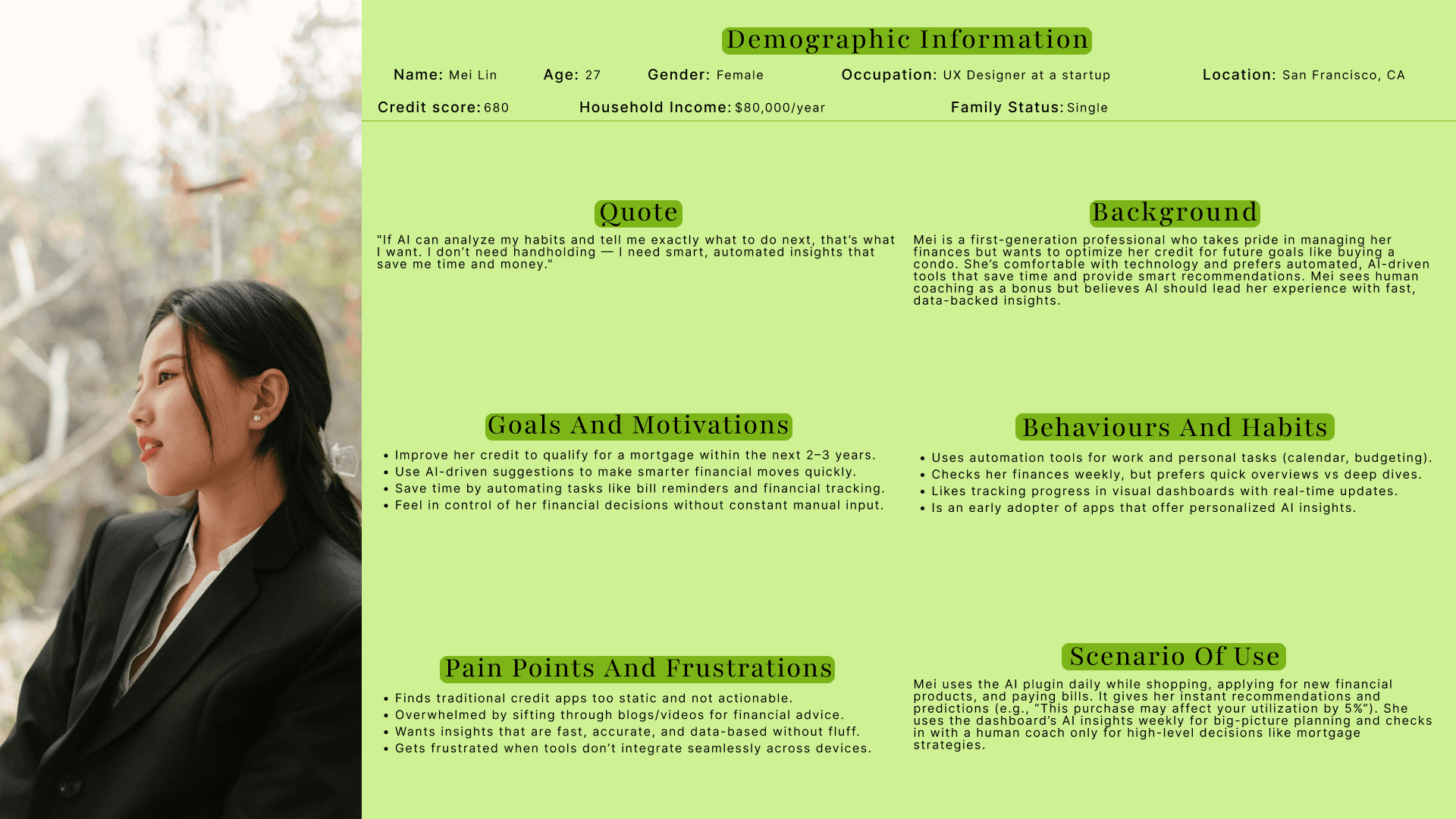
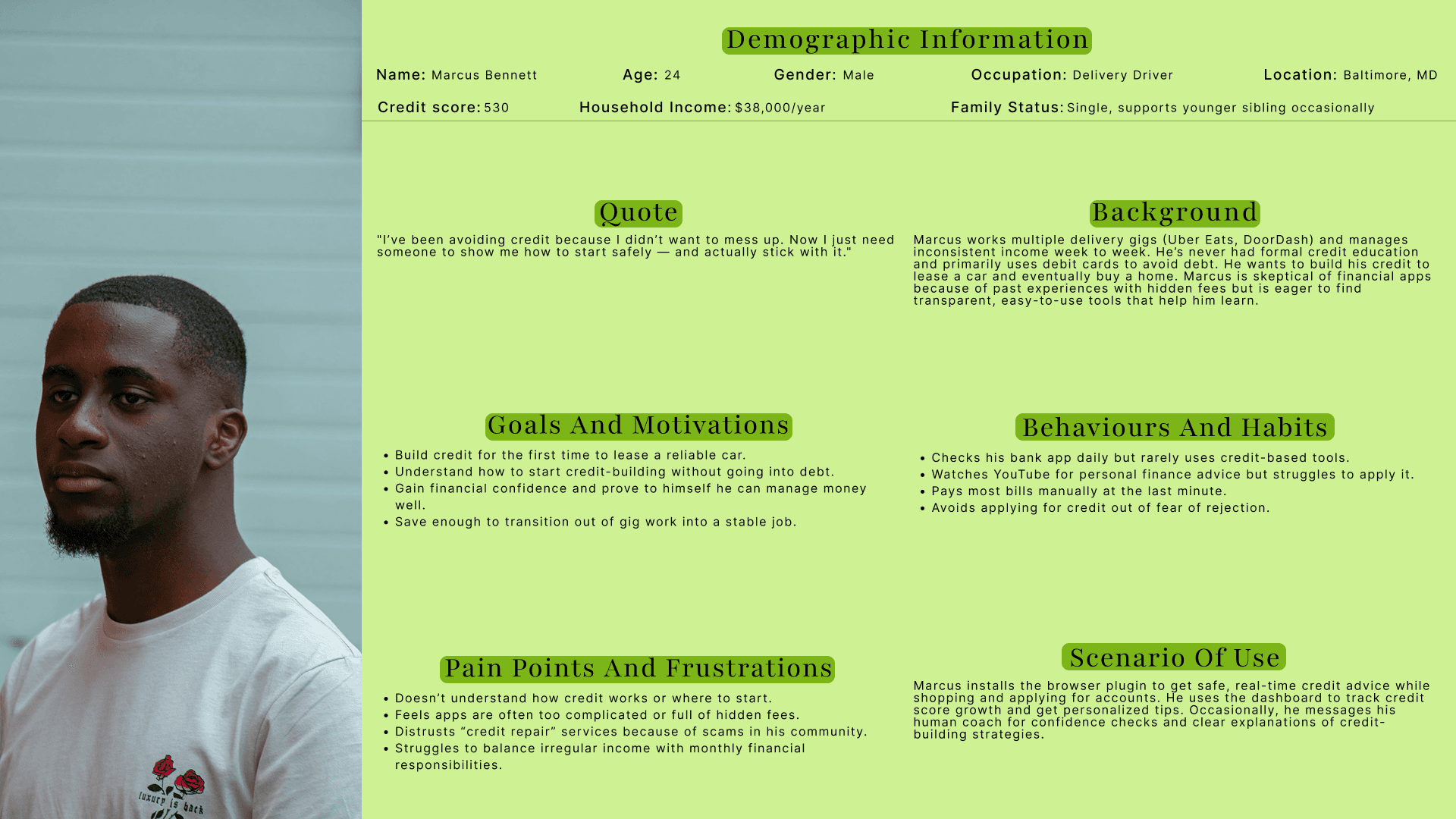
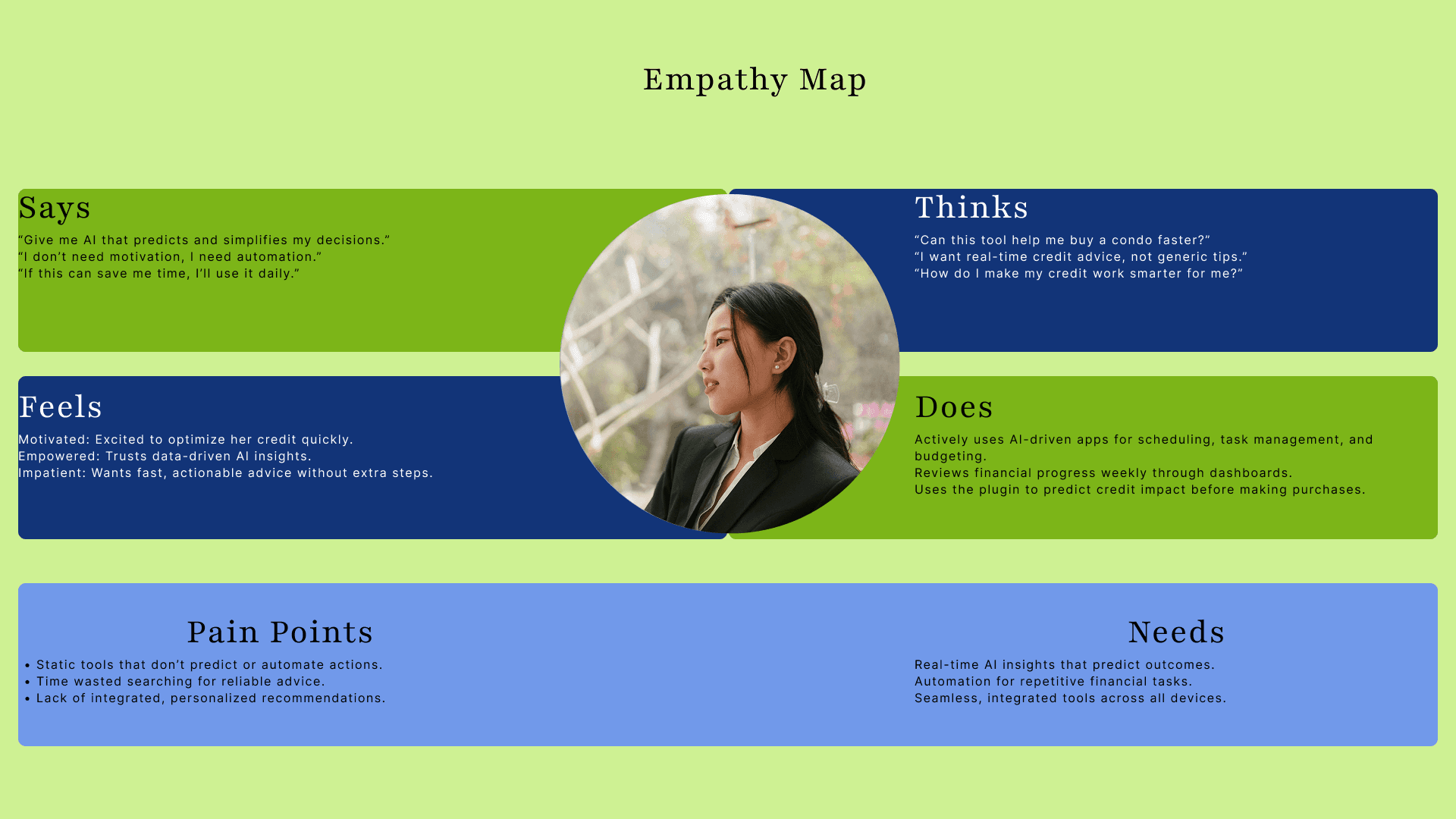
Solution Thinking: Personas & Ideation
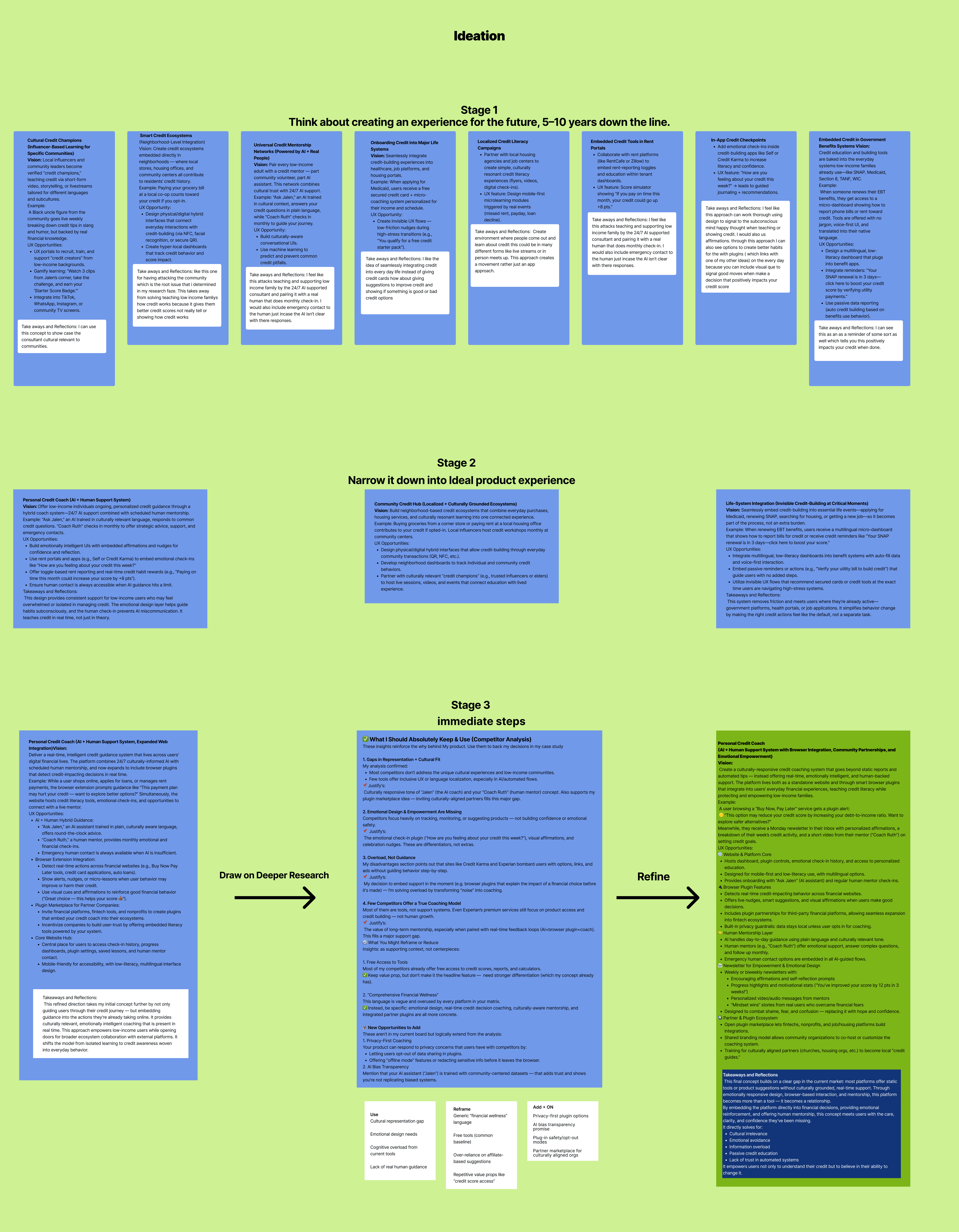
For ideation, I used a multi-stage framework to move from broad, forward-thinking concepts to a refined product vision grounded in research. This process ensured I could explore big possibilities while narrowing them down into realistic and impactful design directions.
Stage 1: Future Visioning (5–10 years out)
I started by brainstorming wide-ranging ideas about what credit education and support could look like in the long term. This included cultural approaches to community education, AI-driven credit assistants, gamified learning systems, and integrated financial ecosystems. The goal at this stage was to generate ambitious, future-facing concepts without limiting scope.Stage 2: Narrowing to the Ideal Product Experience
From the future visioning stage, I refined the concepts into an ideal user experience. Here, I focused on practical product directions such as a personal credit coach with AI and human support, culturally grounded financial education programs, and accessible tools tailored to low-income communities. This stage balanced ambition with usability.Stage 2 (Immediate Steps): Grounding in Research
Using the insights from my deeper research, I translated the ideal experiences into actionable steps. These included integrating AI guidance with real-time feedback, embedding cultural and community touchpoints, and ensuring accessibility through simple, clear interfaces. At this stage, I was moving closer to defining what the MVP (Minimum Viable Product) could look like.Refinement
Finally, I synthesized the best ideas into a more structured solution framework. The refinement stage ensured that the concepts were aligned with user needs discovered in interviews, addressed the gaps identified in research, and maintained a balance between innovation and feasibility.
This staged approach allowed me to think expansively, filter critically, and refine intentionally, making sure that the final design concepts were both visionary and grounded in the realities of my target users.
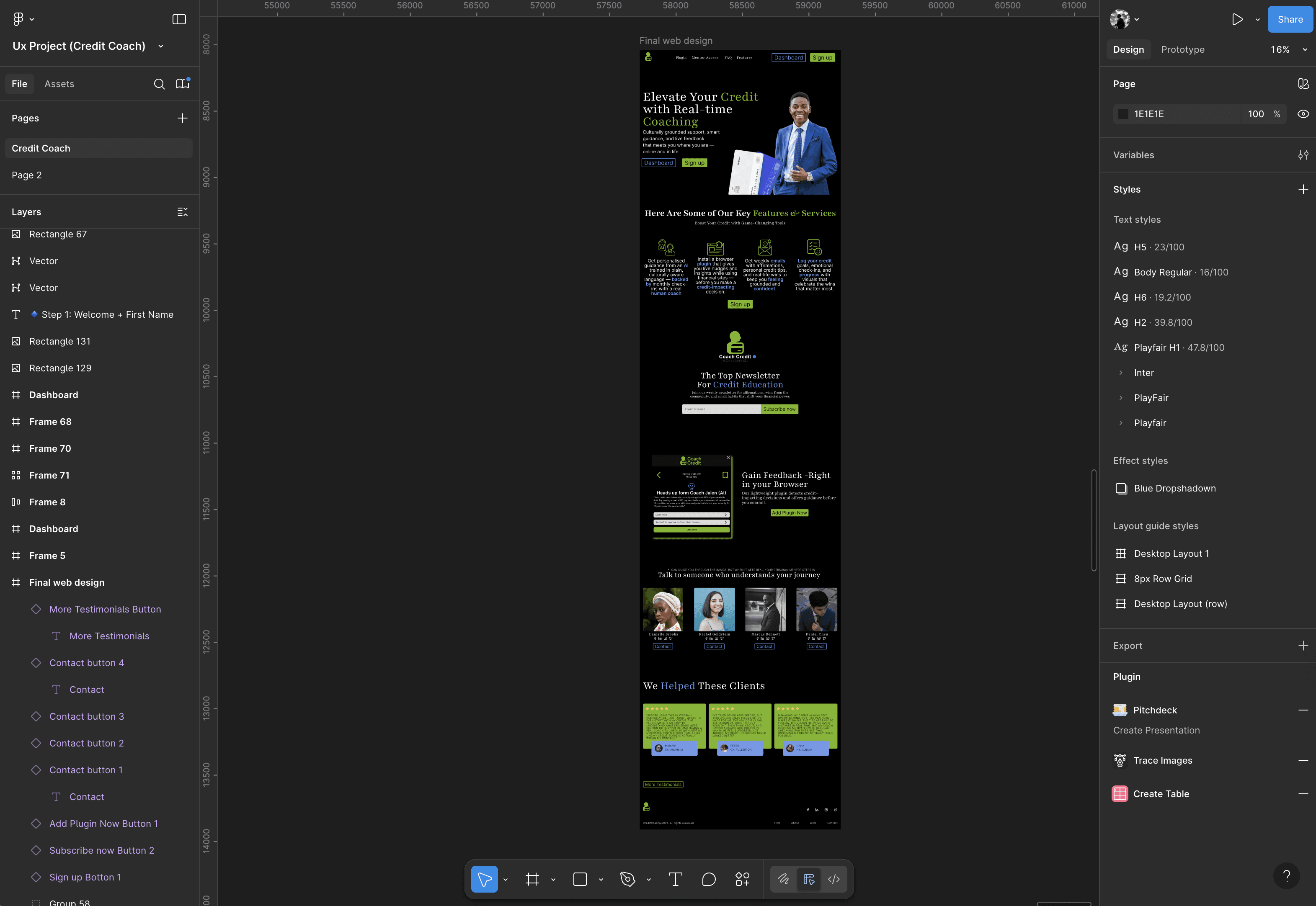
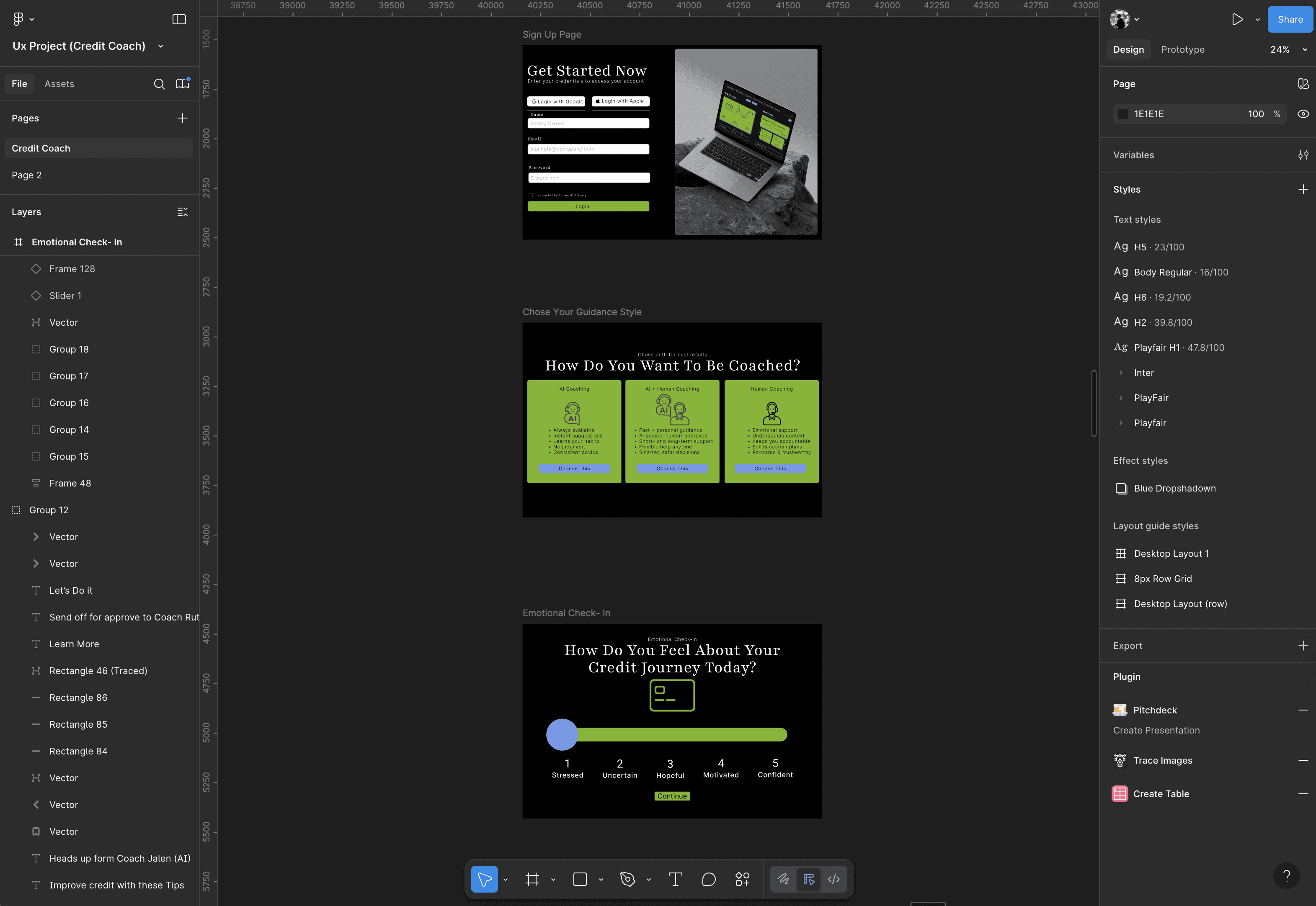
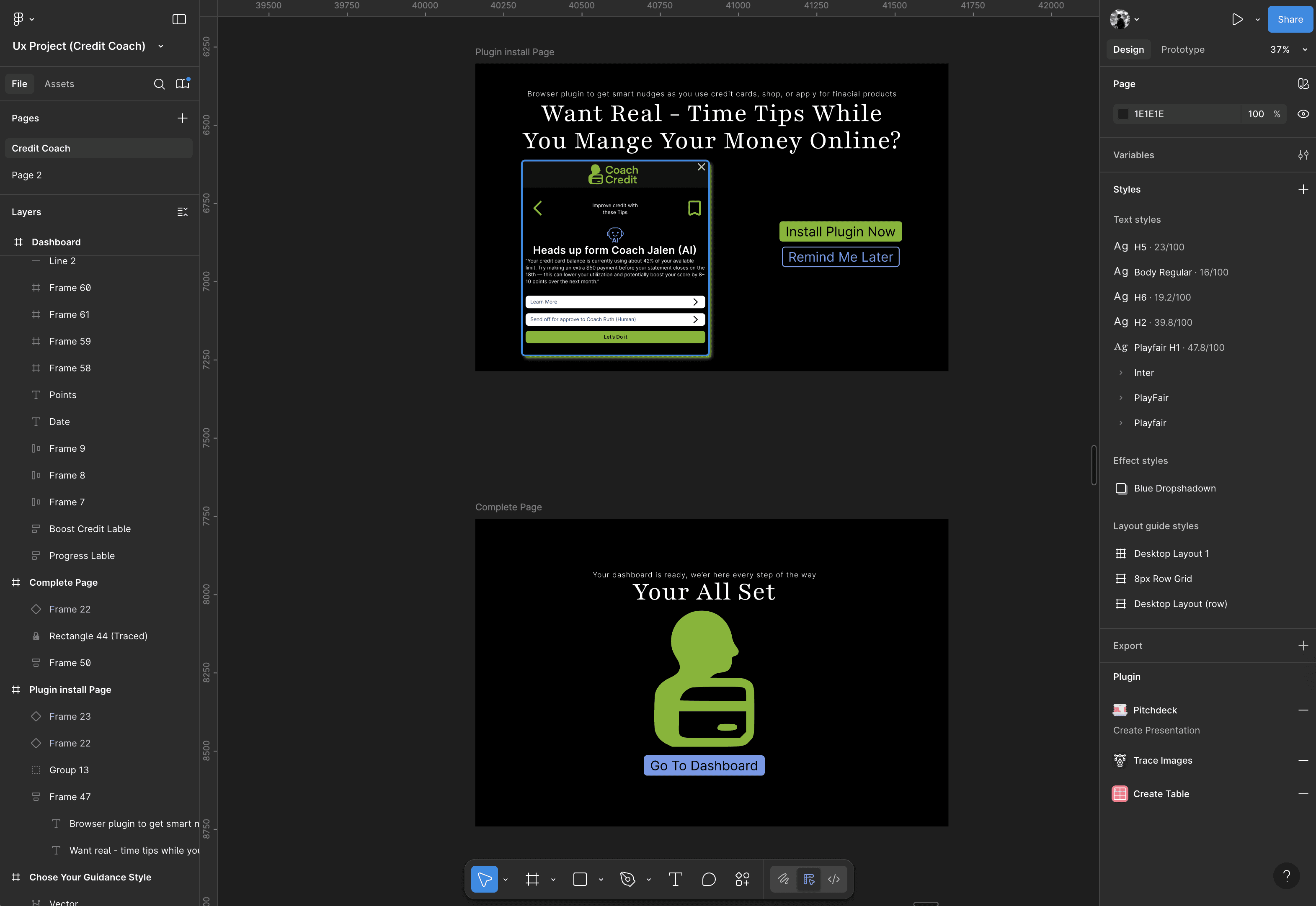
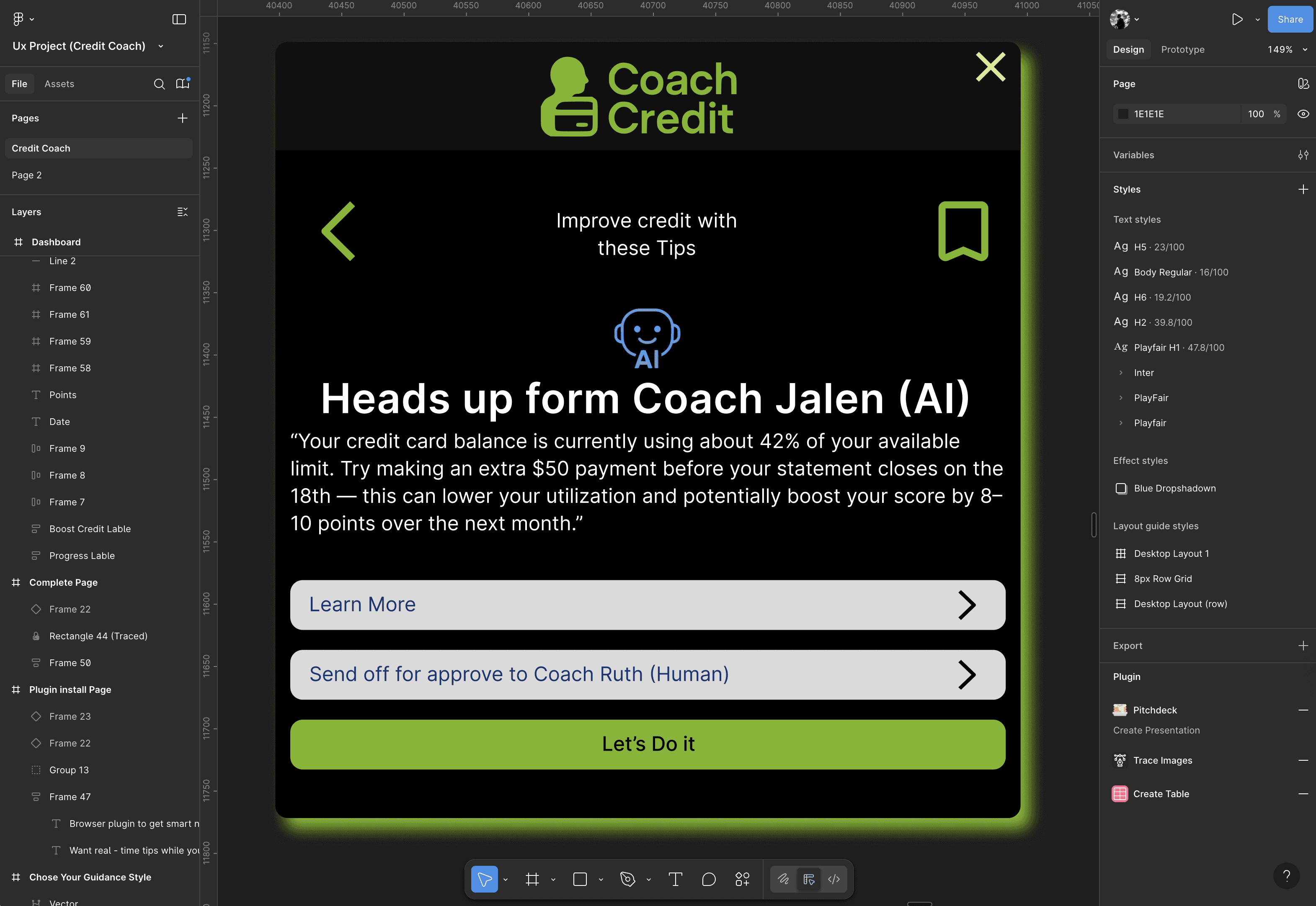
Design Execution: Wireframes & Prototypes
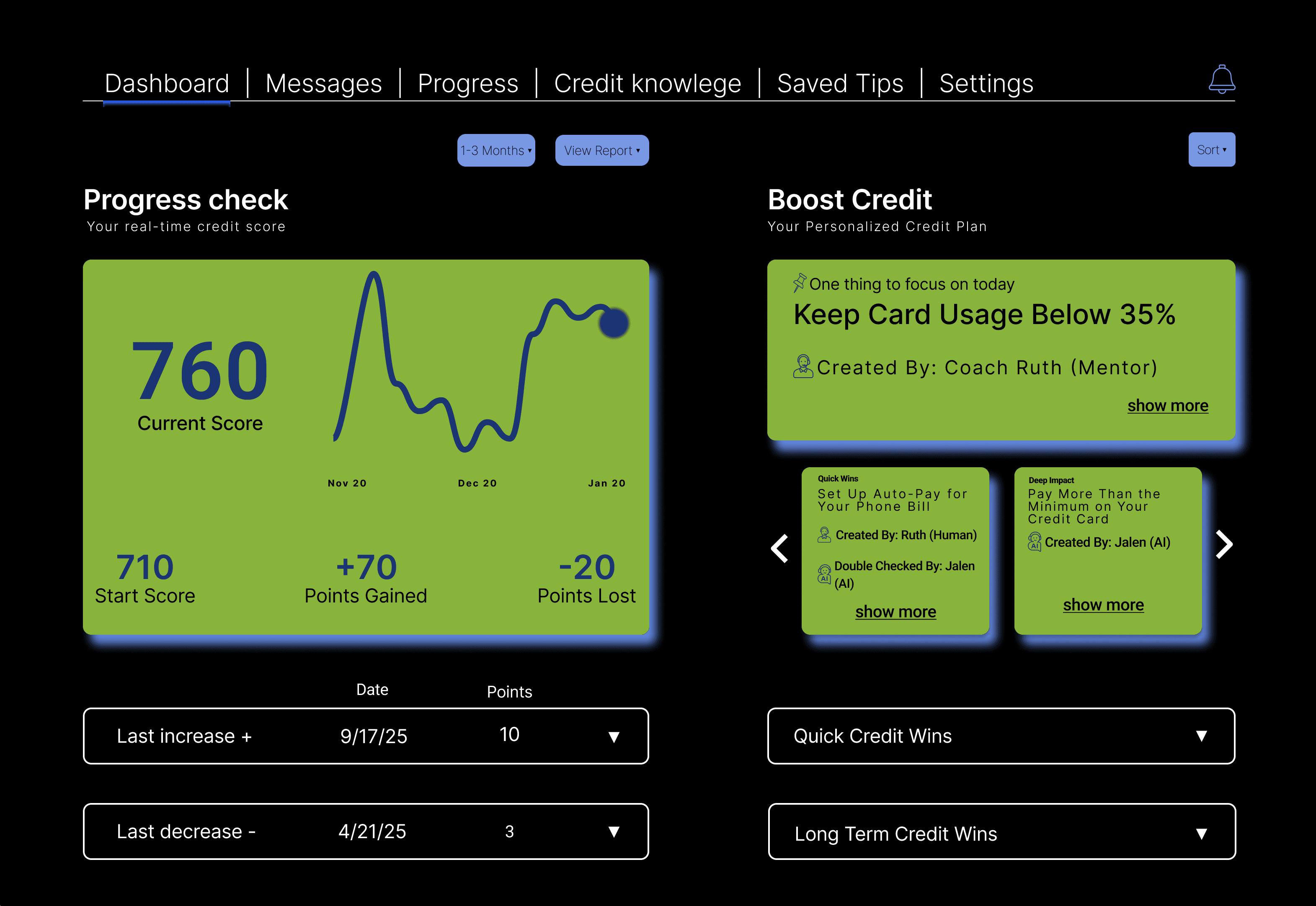
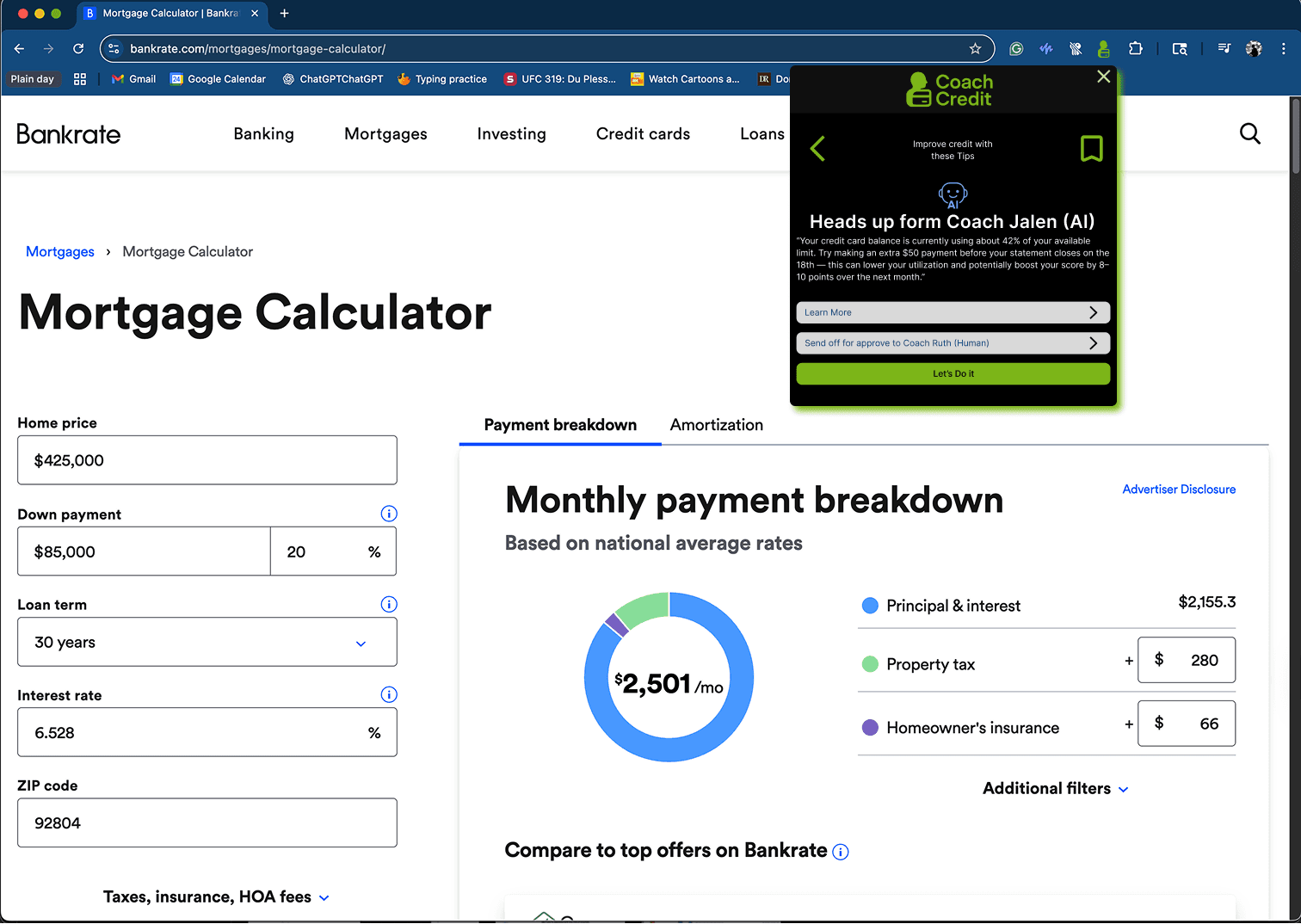
Reflecting on the Design Process Revealed the Importance of Structure, Credible Research, and Continuous Testing
Summary
Throughout this case study, I gained valuable experience that pushed me to grow as a researcher and designer. One of the biggest lessons I learned was the importance of using federal and credible research sources—this was the first time I pulled heavily from places like CFPB, FDIC, and the Federal Reserve, which added depth and reliability to my work. During interviews, I discovered the value of asking follow-up questions to uncover deeper insights that wouldn’t have surfaced otherwise. Looking back, I realized I could have structured the way I collected and organized research data more effectively. While I knew what I wanted to research, I didn’t have a set system for sorting and formatting information, which caused me to lose time restructuring midway through the study. Another key takeaway is that I should have conducted user testing on the site and plugin prototypes earlier. Gathering feedback from real users would have helped refine the experience and strengthen the design. Overall, this project taught me how important structure, credible sources, and continuous testing are to delivering strong, user-centered solutions.
Thank you for taking the time to read through this case study. If you’d like to connect, collaborate, or discuss the project further, my contact information is listed at the bottom of the page—I’d love to share ideas and learn from your perspective.